
Honey’s texture and taste come in a delightful and endlessly surprising range. Each variety of this nature’s golden gift offers unique characteristics and appeal.
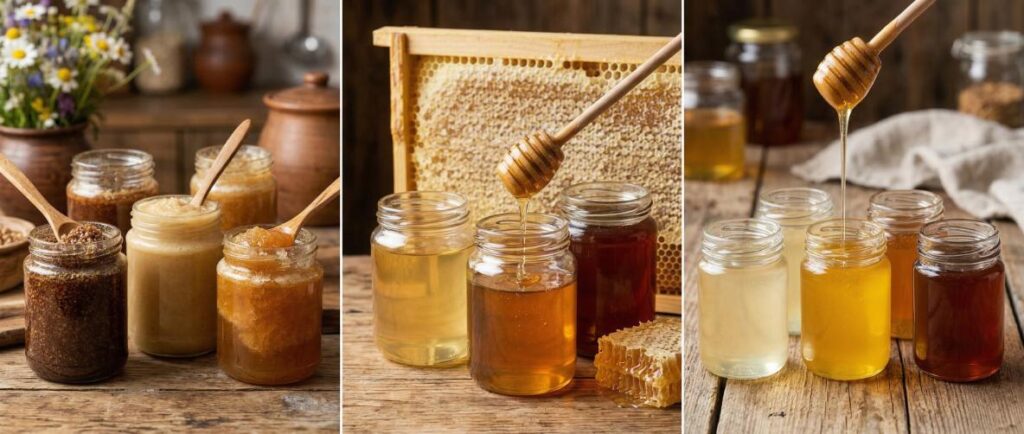
From the smooth, pourable consistency of liquid honey to the thick, spreadable nature of creamed honey, and even the firm, crystallised textures of hard-set varieties, honey’s form is influenced by factors like floral source, temperature, and natural crystallisation processes.
For a broader overview, see our complete guide to honey and its many varieties.
These differences go beyond appearance and texture — they also influence flavour, culinary use, and even the way honey quality is perceived.
In this guide, we explore these diverse forms and show how honey’s natural variation contributes to both its beauty and versatility.
What Determines Honey Texture?
Honey texture depends mainly on the balance of glucose and fructose in the nectar collected by bees, as well as temperature, pollen content, and natural crystallisation processes. These factors determine whether honey remains liquid, becomes creamy, or crystallises into a firm texture over time.
In this guide you will learn:
- what textures real honey can have
- why and how honey texture changes
- how floral origin influences honey flavour
- the difference between monofloral, polyfloral, and single-origin honey
- how honey colour relates to flavour and floral source
What Texture Can Real Honey Have?
1. Comb honey
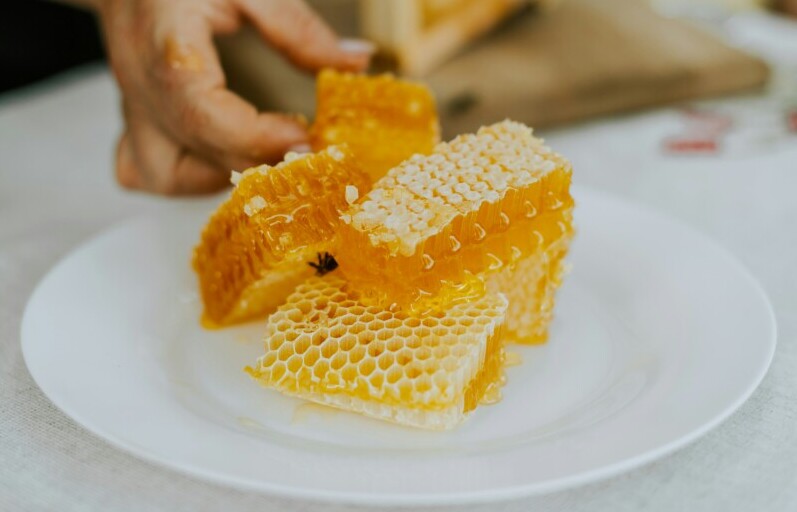
It is honey in its most natural state, still in the beeswax comb.
It’s less common but highly valued for its purity and unique eating experience.
2. Liquid Honey
It has smooth, runny consistency. This is the most common form found in stores and is often used as a drizzle over food or mixed into beverages.
Formation:
Honey remains in a liquid state when freshly extracted from the comb and properly strained. Its low water content (typically below 18%) keeps it fluid initially.

There are cases, however, when honey crystallises while still in the comb, for example, when collected from some plants in spring.
Factors Influencing Texture:
-High-fructose honeys (e.g., acacia or tupelo) stay liquid longer because fructose resists crystallisation.
-Filtering: lightly filtered honey removes large particles like wax and other debris but keeps most of the beneficial components. The more honey is filtered, the longer it can stay in its liquid form but the more essential nutrients it loses.
-Storage temperature and the absence of natural crystallisation “seeds” like pollen or wax can also preserve its liquid state.
How It Changes:
Over time, liquid honey will naturally crystallise, especially if stored in cooler environments.
3. Chunk honey
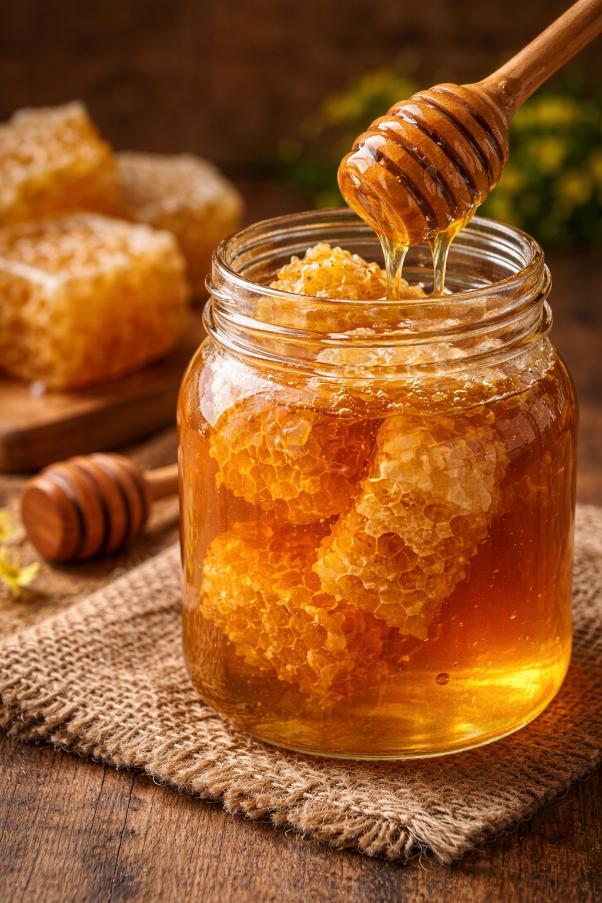
It is basically a combination of Comb honey + Liquid Honey.
Chunk honey includes pieces of comb honey submerged in liquid honey, offering a mix of textures.
4. Soft Set Honey
This honey is smooth and creamy, with a spreadable consistency similar to soft butter. It’s easy to use on toast or in recipes requiring a thick but pliable texture.
Formation:
Soft set honey is created by controlling the crystallisation process. Honey is seeded with fine crystals (usually from previously crystallised honey) and stirred to ensure even crystal size, resulting in a creamy, uniform texture.
Why It’s Popular:
Soft set honey offers the convenience of a spreadable texture without the graininess of uncontrolled crystallisation.

5. Hard Set Honey
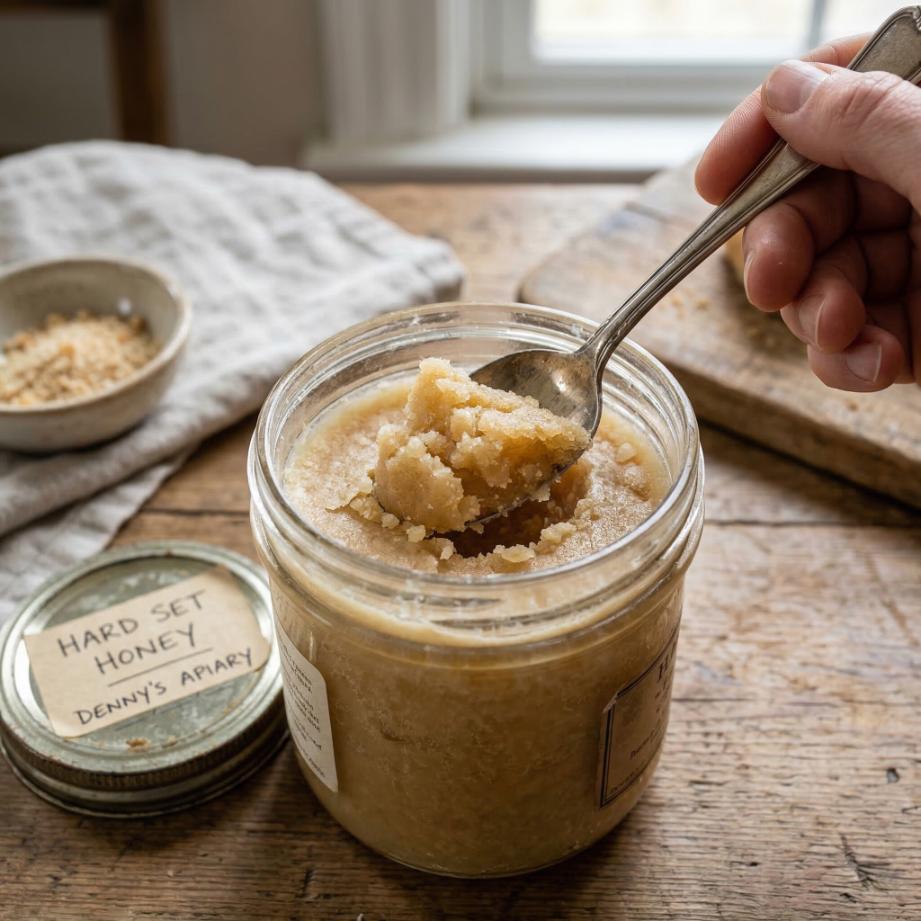
Dense and solid, hard set honey is firm and requires a spoon or knife to scoop out. It is often grainy in texture.
Formation:
Occurs when honey crystallises naturally over time, typically due to high glucose content (e.g., clover honey).
Why It Happens:
- Glucose forms crystals more readily than fructose.
- Cooler storage temperatures accelerate crystallisation.
How to Restore:
Gently warm the honey (e.g., in a warm water bath) to liquefy it again, though it will crystallise back some time later and repeated heating can degrade its nutrients.
6. Medium Set Honey
It has a semi-solid texture that is thicker than soft set but less rigid than hard set honey. It can still be spreadable but with more resistance.
- Formation:
Medium set honey results from partial crystallisation, where the crystals are larger but not fully developed. - Why It Forms:
- A mix of glucose and fructose content leads to intermediate crystallisation.
- Storage at mildly cool temperatures may encourage this texture.
- Uses:
Works well as a spread as it is less messy than liquid honey.
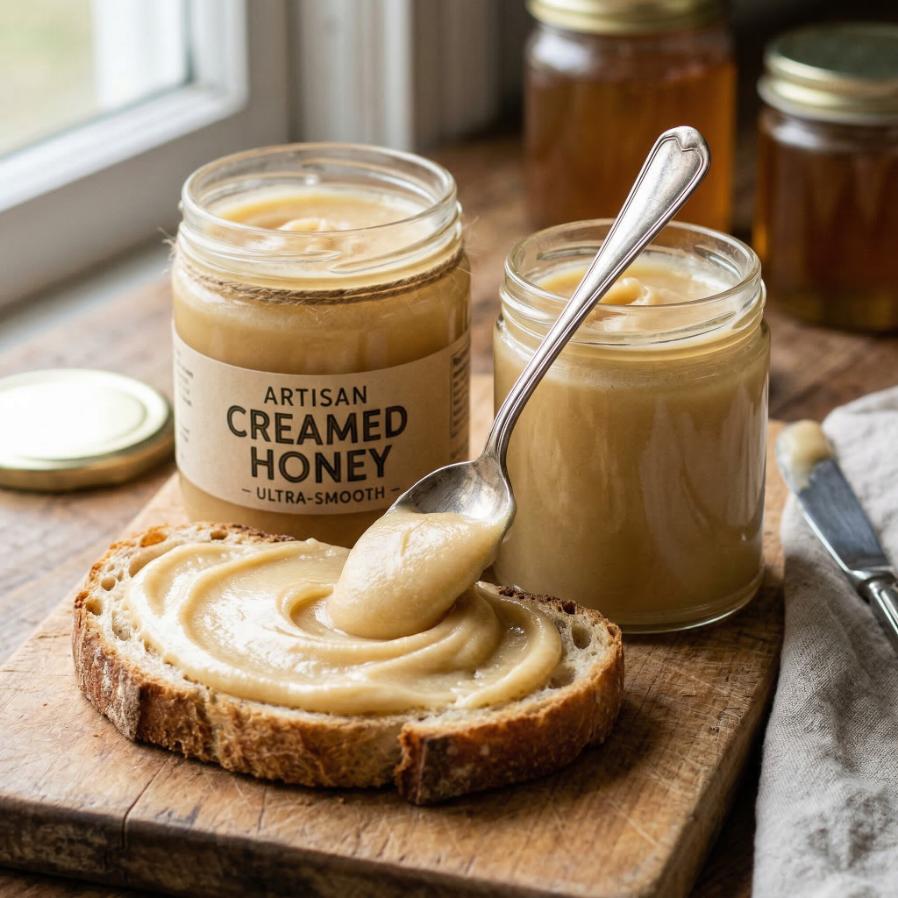
7. Creamed Honey
Ultra-smooth and velvety, creamed honey has a texture similar to whipped butter. It’s uniform and spreadable, free of noticeable crystals.
Formation:
Creamed honey is intentionally processed by seeding liquid honey with fine crystals and stirring it at controlled temperatures. This process ensures consistent texture and prevents further crystallisation.
Why It’s Special:
- Easy to use and more visually appealing.
- Retains natural nutrients and enzymes of raw honey.
Storage Impact:
Creamed honey holds its texture well and resists hardening, making it a long-lasting choice.
Why and How Honey Texture Changes
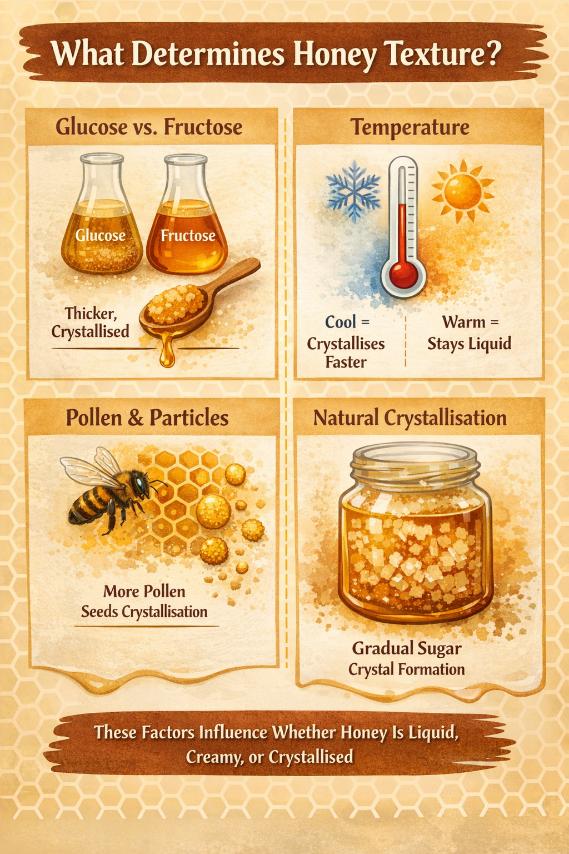
Honey is a dynamic natural product, and its texture can change over time due to a fascinating interplay of natural processes.
From its initial liquid state to thickening or crystallising into a soft or hard set, these changes are primarily influenced by the floral source, sugar composition, storage conditions, and even environmental factors like temperature.
The balance of glucose and fructose in honey, for example, determines how quickly it crystallises, while cooler temperatures can encourage the process.
Understanding why and how honey’s texture changes not only demystifies this natural transformation but also highlights the purity and authenticity of this remarkable food. Let us look closely at those factors.
Crystallisation:
- Honey is a supersaturated sugar solution. Over time, glucose separates from the water and forms crystals, changing the texture.
- Higher glucose content leads to faster crystallisation (e.g., clover honey), while higher fructose delays it (e.g., acacia honey).
Learn more about this natural process in our guide to Honey Crystallisation.
Temperature:
- Cooler storage speeds up crystallisation, while warmer environments delay it.
- Extreme heat can liquefy crystallised honey but may degrade its enzymes and nutrients.
Pollen and Wax Content:
- Natural honey with more pollen and impurities has more “seeds” to initiate crystallisation, leading to faster texture changes.
Moisture Content:
- Honey with higher water content tends to crystallise more slowly, while low-moisture honeys crystallise faster and more densely.
Why Is Some Honey Thick and Some Runny?
The texture of honey depends largely on the ratio of glucose and fructose in the nectar collected by bees. Honeys with higher fructose levels tend to remain liquid for longer periods, while honeys with more glucose crystallise more quickly, creating thicker or grainier textures.
Floral source therefore plays a major role in determining honey texture.
How Floral Origin Shapes Honey Flavour
Honey is far more than a simple sweetener. Its flavour reflects the plants visited by bees and the landscapes where nectar is collected. Some honeys express the character of a single dominant flower, while others capture the diversity of an entire ecosystem. Understanding these differences helps explain why honeys vary so widely in aroma, sweetness, and intensity.
Honey flavour is largely determined by the floral sources visited by bees. Depending on the nectar collected, honey may be classified as monofloral or polyfloral.
Monofloral, Polyfloral, and Single-Origin Honey
Monofloral vs Polyfloral Honey
Honey flavour is strongly influenced by the floral sources visited by bees.
Monofloral honey is produced when nectar from one plant species predominates in the honey, giving it a recognisable flavour profile. Examples include acacia, lavender, and chestnut honey.
Polyfloral honey, also called multifloral or wildflower honey, is produced from nectar collected from many flowering plants within the same landscape. Its flavour depends on local flora, season, and environmental conditions.
The distinction between monofloral and polyfloral honey is explained in more detail in our guide to Types of Honey.
Single-Origin Honey
Honey can also be classified according to its geographic origin. In this classification, single-origin honey refers to honey harvested from a specific region or landscape, where the local plants, climate, and environmental conditions influence its flavour, aroma, colour, and texture.
Unlike blended honeys, which may combine honey from several regions or even different countries to achieve a consistent flavour, single-origin honey reflects the unique character of the place where bees forage.
A single-origin honey may be monofloral or polyfloral, depending on whether one plant species or many contribute nectar within that region.
Examples include:
- Manuka honey from New Zealand
- Sidr honey from Yemen
- Lavender honey from Provence, France
- Heather honey from Scotland
Because of their strong connection to place, single-origin honeys are often valued for their distinctive flavour and traceable origin.
Single-Origin Honey vs Monofloral Honey
Although the terms are sometimes used interchangeably, they describe different aspects of honey.
| Feature | Single-origin honey | Monofloral honey |
| Main focus | Geographic location | Dominant floral source |
| Source | One region or apiary | Predominantly one flower species |
| Floral diversity | Can be mono- or polyfloral | Mostly one flower species |
| Example | Wildflower honey from Yorkshire | Acacia honey from Italy |
A honey can be both single-origin and monofloral if it comes from one geographic area and one dominant flower source.
However, single-origin honey may also be polyfloral, reflecting the variety of plants growing within that region.
Colour Spectrum of Honey
Honey is a visual marvel, with colours that range from pale, almost transparent gold to deep, rich amber and even dark molasses-like brown.
The colour of honey is more than an aesthetic feature — it often offers clues about floral origin, flavour intensity, and mineral content. For example, light-colored honeys like acacia or clover have mild, delicate flavours, while darker varieties such as buckwheat or heather boast robust, earthy notes and higher nutrient content.
Some monofloral honeys are instantly recognisable by their signature shades, while polyfloral honeys offer a blend of tones.
The colour of honey is more than just aesthetic — it’s a window into its origin, flavour, and nutritional richness.
Here are some examples:
Light Honey
- Mild, delicate flavour
- Examples: Acacia, Clover
Medium Honey
- Balanced sweetness
- Examples: Orange blossom, Alfalfa
Dark Honey
- Intense, robust flavour
- Examples: Buckwheat, Chestnut

Quick Recommendations
- For maximum health value: raw, minimally processed honey
- For delicate flavour: light monofloral honeys such as acacia
- For robust flavour: dark honeys such as buckwheat, chestnut, or forest honey
- For versatility: medium-coloured liquid or soft set honey
FAQ: Honey’s Texture and Taste
1. Why does honey crystallise over time?
Honey naturally crystallises because it is a supersaturated sugar solution. Glucose gradually separates from water and forms crystals. This is a natural process and does not mean the honey has spoiled.
2. Is crystallised honey still good to eat?
Yes. Crystallised honey is perfectly safe and retains its flavour and nutrients. Some people even prefer the thicker texture of crystallised honey.
3. How can crystallised honey be made liquid again?
Place the jar in a warm water bath (not boiling) and stir occasionally until the crystals dissolve. Avoid overheating, as high temperatures can damage honey’s natural enzymes.
4. Why do some honeys stay liquid longer than others?
The texture of honey depends largely on the balance of glucose and fructose. Honeys with higher fructose levels, such as acacia or tupelo honey, tend to remain liquid longer than honeys with more glucose.
5. What determines the texture of honey?
Honey texture is influenced by several factors, including floral source, sugar composition, storage temperature, moisture content, and the presence of natural particles such as pollen.
6. Does honey texture indicate quality?
Not necessarily. High-quality honey can crystallise quickly or remain liquid depending on its natural sugar composition. Texture alone is not a reliable indicator of quality.
7. What is the difference between creamed honey and crystallised honey?
Creamed honey is produced by controlled crystallisation, which creates very fine crystals and a smooth, spreadable texture. Natural crystallisation may produce larger crystals and a grainier texture.
8. Why does honey sometimes become grainy?
Graininess occurs when larger glucose crystals form during crystallisation. This often happens when crystallisation occurs slowly or unevenly.
9. Why do different honeys taste different?
Honey flavour depends mainly on the flowers visited by bees. Different plants produce nectar with distinct sugar compositions and aromatic compounds, which influence the taste, aroma, and colour of honey.
10. Why is some honey darker than others?
Honey colour is influenced by the floral source, mineral content, and antioxidant compounds. Darker honeys, such as buckwheat or forest honey, often have stronger, more robust flavours.
11. What honey texture is best for spreading?
Soft-set or creamed honey is usually the easiest to spread because its fine crystals create a smooth, butter-like consistency.
12. How should honey be stored to preserve its texture?
Store honey in a sealed container at room temperature (around 18–22°C / 64–72°F). Refrigeration accelerates crystallisation and is generally not recommended.
13. Can crystallised honey be used in cooking or baking?
Yes. Crystallised honey melts during cooking and provides the same sweetness and flavour as liquid honey.
14. Why does raw honey often crystallise faster?
Raw honey contains natural pollen and microscopic wax particles that act as crystallisation seeds, encouraging glucose crystals to form more quickly.
15. Which honey has the smoothest texture?
Creamed honey usually has the smoothest texture because it is produced through controlled crystallisation that creates extremely fine crystals.