A few weeks ago I made a jar of garlic fermented in raw honey — mostly out of curiosity, just to try something old-fashioned and natural… and it turned out much better than I expected.
I was a bit worried that it would become something strong, maybe even harsh, or with a funny taste. Mainly I was concern that I would waste perfect honey that had been collected by my lovely bees.
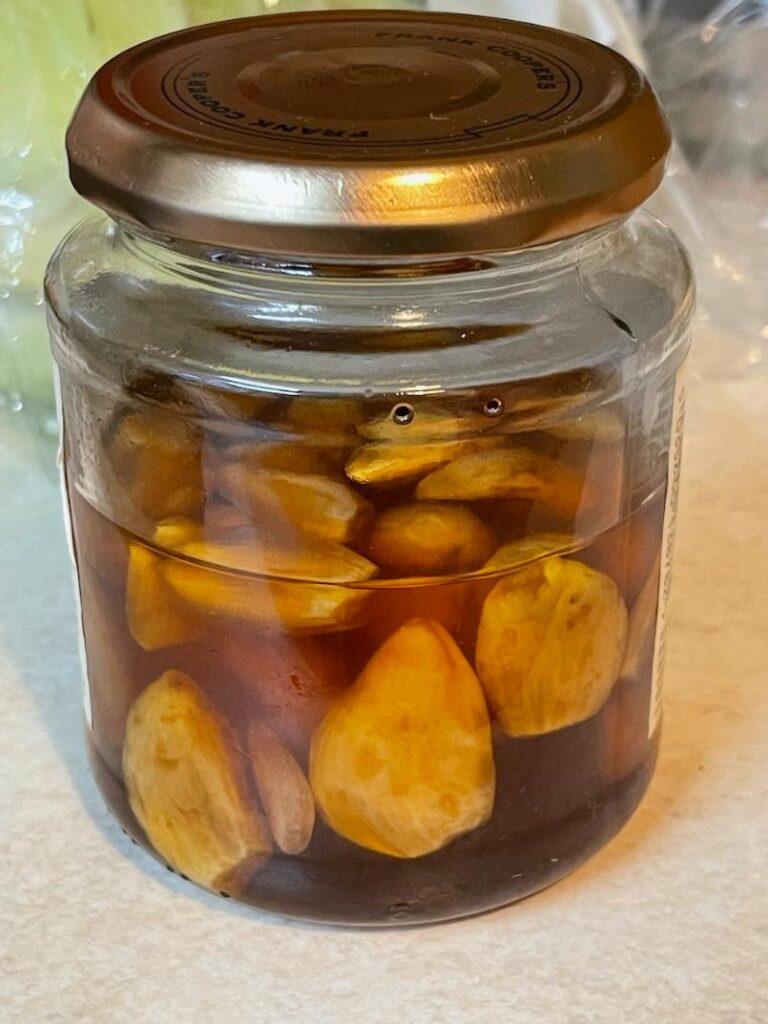
However, what I got was surprisingly delicious. The garlic became mellow and slightly sweet, and the honey turned into a pourable, garlicky elixir that I now drizzle on raw and roasted veggies, add to my homemade hummus and even smoothies.
As you can see in this photo I have already eaten nearly half of the jar. 🙂
If you’ve been curious about this viral kitchen project, or if you want a natural immune-boosting remedy that’s actually tasty, or if you want a natural, flavourful pantry staple with a long history of traditional use — this guide covers everything you need to know: how garlic honey fermentation works, what science says about its potential benefits, safety tips, the best honey varieties to use, and creative ways to enjoy it. Here’s what you”ll find:
- What Is Garlic Fermented in Honey?
- Why Garlic and Honey Work So Well Together
- What Happens During Garlic Honey Fermentation?
- Health Benefits of Garlic Fermented in Honey (And What Science Says)
- What Makes Garlic Honey Ferment Worth Trying
- My Easy Method of Making Garlic Honey Ferment
- Step-by-Step Garlic Honey Ferment
- Best Honey Varieties for Garlic Ferment
- Safety Tips You Should Know + Extra Tips
- Fun & Historical Facts About Garlic and Honey
- Frequently Asked Questions about Garlic Honey Ferment
What Is Garlic Fermented in Honey?
Garlic fermented in honey is exactly what it sounds like: fresh garlic cloves submerged in raw honey and left to slowly ferment over time.
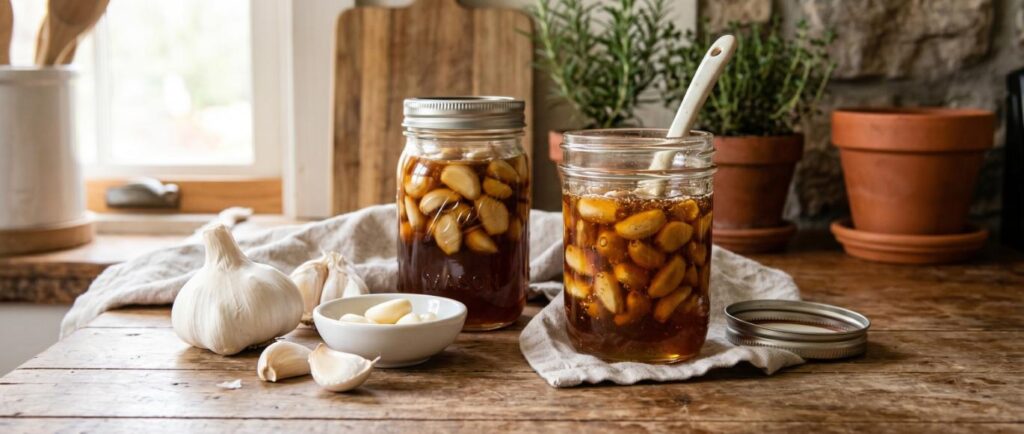
At first glance, it may seem unlikely that fermentation could happen in honey because honey naturally has very low moisture content and strong antimicrobial properties. However, once garlic is added, something fascinating begins to happen.
The honey starts drawing moisture out of the garlic through osmosis — a natural movement of water from the garlic into the honey. This gradually thins the honey and helps fermentation begin.
As the moisture content rises slightly, naturally occurring yeasts and beneficial microbes become active. Over days and weeks:
- tiny bubbles begin to appear,
- the honey becomes thinner and more pourable,
- the garlic softens,
- and the flavour transforms completely.
The sharp bite of raw garlic mellows into something rich, savoury, sweet, and deeply aromatic.
This method has been used in various traditional food cultures for centuries — long before people understood fermentation scientifically. Today, garlic fermented in honey has become popular again among natural food enthusiasts and people looking for creative ways to preserve garlic naturally.
Why Garlic and Honey Work So Well Together
One of the reasons this ferment is so interesting is that both garlic and honey are remarkable ingredients individually.
Garlic contains sulfur compounds, including allicin, which forms when garlic is chopped, sliced, or crushed.
Allicin has been widely studied for its antimicrobial and antioxidant properties.
Raw honey is naturally acidic, low in water activity, and contains enzymes, antioxidants, and small amounts of naturally occurring yeasts and beneficial microbes. Certain varieties of honey are also known for particularly strong antibacterial activity. (You can learn more in my guide to honey’s antibacterial properties.)
Together, garlic and honey create an environment where:
- garlic slowly infuses the honey,
- flavours mellow and deepen,
- natural fermentation begins,
- and the mixture develops into something far more complex than the two ingredients alone.
Research on fermented garlic honey specifically is still limited, but garlic and honey have both been studied individually for:
- antimicrobial activity,
- antioxidant potential,
- soothing sore throats,
- and general immune support.
That said, I think it’s important to keep expectations realistic. This is not a miracle cure — it’s a traditional food preparation with a fascinating history and some promising science behind its ingredients.
What Happens During Garlic Honey Fermentation?
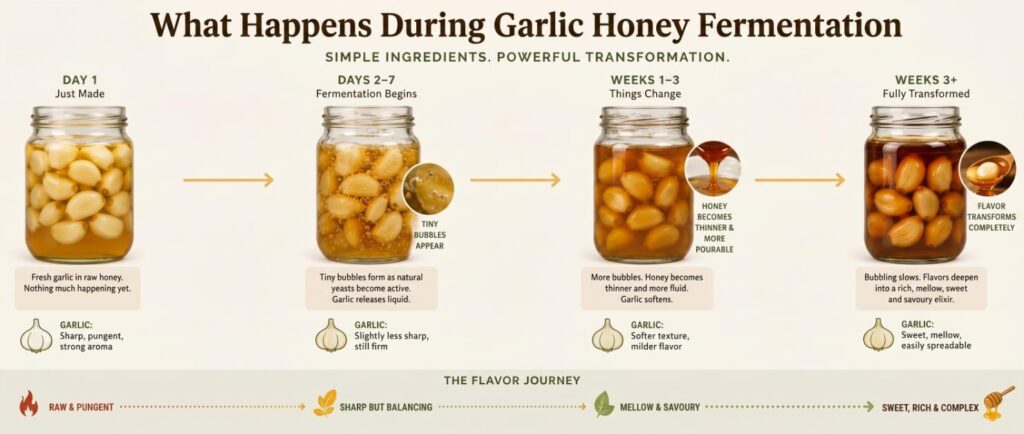
When garlic is submerged in raw honey:
- The honey pulls water out of the garlic cloves.
- The extra moisture slightly dilutes the honey.
- Wild yeasts naturally present in raw honey and garlic become active.
- Fermentation begins.
- Carbon dioxide gas forms, creating bubbles.
- The honey becomes more liquid over time.
This explains why:
- the garlic may float,
- bubbles appear,
- pressure builds in the jar,
- and the honey becomes thinner.
All of this is completely normal.
The process is not identical to vegetable ferments made with salt brine, but it follows similar microbial principles. Garlic honey ferment is essentially a slow transformation driven by enzymes, osmotic exchange, and natural microbial activity.
Health Benefits of Garlic Fermented in Honey (And What Science Says)
People often make garlic honey ferment because of its traditional reputation as a wellness-supporting food.
Here’s why the combination attracts so much interest:
Garlic
Garlic has been studied for:
- antimicrobial activity,
- antioxidant effects,
- cardiovascular support,
- and immune-related properties.
Much of garlic’s reputation comes from allicin and related sulfur compounds formed when garlic cells are broken (that’s why it’s recommended to crush garlic and leave for a few minutes before using it).
Raw Honey
Raw honey has been traditionally used for:
- soothing sore throats,
- calming coughs,
- wound care,
- and general wellness support.
Some honeys also demonstrate notable antibacterial activity due to hydrogen peroxide production, acidity, osmotic effects, and plant-derived compounds.
(If you’re interested in how honey quality is measured, you may want to check out my article on honey quality indicators and ratings.)
Garlic + Honey Together
While there are laboratory studies exploring the antimicrobial synergy of garlic and honey, direct large-scale clinical studies on fermented garlic honey itself are still limited.
That’s why I prefer to think of this ferment as:
- a nutrient-rich traditional food,
- a flavourful natural preserve,
- and a comforting kitchen staple,
rather than a guaranteed “immune cure.”
Still, there’s a reason why different variations of this remedy have survived for generations.
What Makes Garlic Honey Ferment Worth Trying
I can think of 4 reasons why you can try it at least once.
1. It’s incredibly easy
No special equipment needed. I only used:
- a clean glass jar,
- a knife,
- and a spoon.
2. The flavour transformation is amazing
This surprised me the most.
The honey takes on a mellow savoury sweetness, while the garlic becomes soft, rich, and much less aggressive than raw garlic.
3. It’s versatile in the kitchen
I use mine:
- drizzled over roasted vegetables,
- in vinaigrettes,
- in homemade hummus,
- over grain bowls,
- mixed into dressing,
- and occasionally straight off the spoon.
It also works beautifully in:
- stir fries,
- hot honey-style sauces,
- cheese boards,
- and roasted carrot glazes.
4. It stores beautifully
As long as the garlic stays submerged and clean utensils are used, a batch can last for months.
There’s something genuinely satisfying about making a jar once and watching it slowly improve over time.
My Easy Method of Making Garlic Honey Ferment
Here’s exactly how I made mine — and what I learned along the way:
Ingredients (only 2):
- Raw honey (local or organic works best for flavour and fermentation) – you need just enough to completely fill a jar of your choice with garlic cloves in it.
- 1 head of fresh garlic (about 10-12 cloves) – if your jar is tiny.
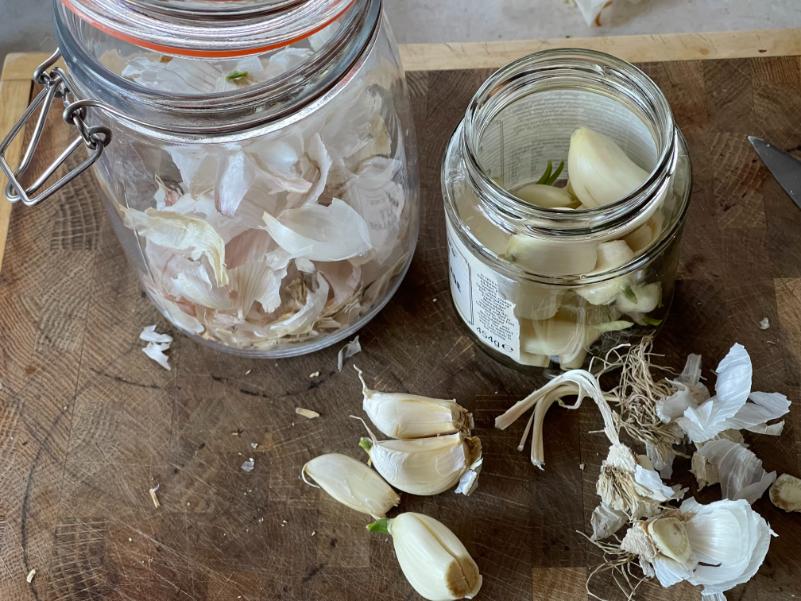
I actually used 3 heads of garlic for the jar in the photo:
I filled my jar to its neck, leaving just enough space for the cloves to be fully submerged in honey.
That’s it.
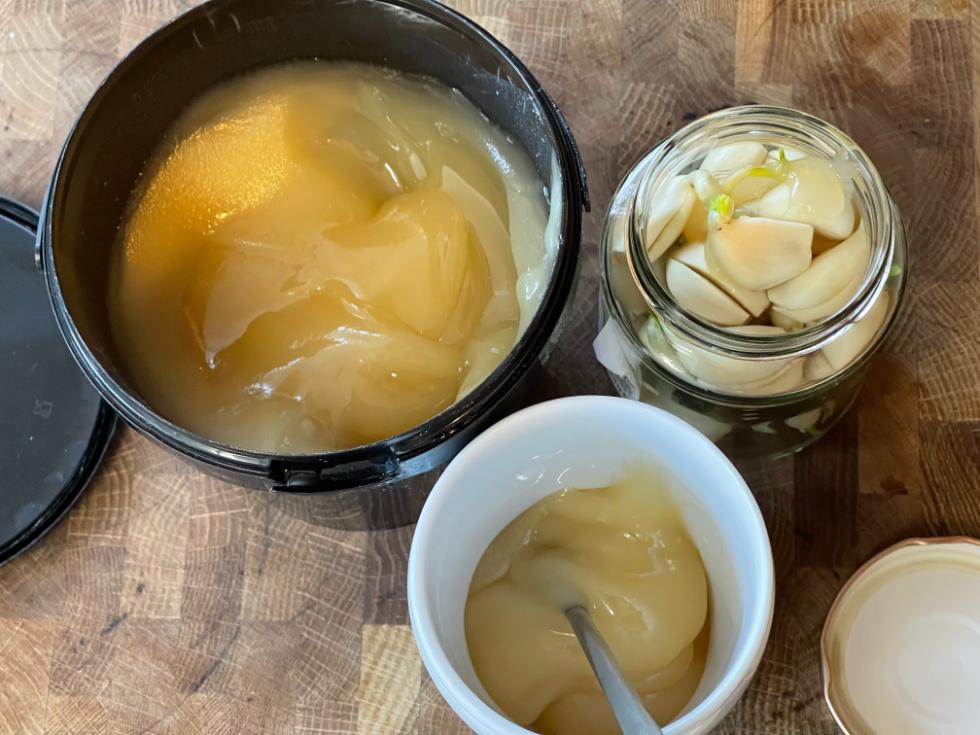
No preservatives, no vinegar, no additives — just two ingredients and time.
Using high-quality raw honey and fresh, firm garlic makes a huge difference to the final flavour.
As an experiment, I have also used sprouted garlic, and the taste was absolutely fine.
I also used set honey, which I partially liquefied using the method described in How To Decrystallise Honey Safely (Without Damaging It).
Step-by-Step Garlic Honey Ferment
1. Peel the Garlic
I separated and peeled all the cloves and trimmed off the dry root ends.
You can:
- leave the cloves whole,
- lightly crush them,
- or slice a few open.
Crushing or slicing helps release more allicin and may kickstart fermentation slightly faster.
2. Add Garlic to the Jar
Once peeled, I drop the cloves into a clean glass jar, leaving some room at the top for honey and air.
3. Pour in the Honey
I slowly pour raw honey over the garlic until the cloves are fully covered. Air bubbles may form as the honey settles, so I give the jar a gentle shake or stir to help the honey soak in around each clove.
The honey will gradually grow thinner as fermentation moves along.
4. Let it Ferment
After sealing the jar, I keep it at room temperature in the kitchen cupboard, out of direct sunlight.
During the first week only I open the lid every day to release pressure (“burping” the jar) and I rotate and tip the jar gently to mix the honey and garlic.
On the second day tiny bubbles appear as fermentation starts, and the honey becomes thinner over time. This change shows that the natural process is moving right along.
That’s a good sign.
By the end of the first week, bubbling slows noticeably and foaming stops. I then leave the jar mostly undisturbed for another week.
5. Enjoy and Store
After two weeks, the flavour is already mellow and developed. I can taste the unique flavour of the final product, and it is well worth the effort.
You can start using it after the first week, or let it ferment for weeks for a deeper, richer flavour. When you have reached the flavour you like, store the jar in a cool cupboard (or if desired, the fridge – to slow down further fermentation).
Best Honey Varieties for Garlic Ferment
One thing I did not expect was just how much the honey variety changes the final result.
Wildflower Honey
Balanced, floral, versatile, and excellent for everyday use.
Manuka Honey
Earthy, medicinal, and intensely bold. Because of its strong antibacterial activity, fermentation may proceed more slowly.
(If you enjoy medicinal-style honeys, you may also be interested in reading about rare and high-activity honeys such as Manuka UMF grades.)
Buckwheat Honey
Dark, malty, and rich with almost molasses-like depth.
Acacia Honey
Very mild and naturally slow to crystallise. Produces a lighter, gentler ferment.
Clover Honey
Sweet, approachable, and familiar.
Heather Honey
Earthy, aromatic, and slightly herbal with a very distinctive character.
My recommendation?
Try making two small jars with different honeys side by side.
Safety Tips You Should Know + Extra Tips
This is where most readers have questions — and for good reason.
- Botulism risk is extremely low in honey ferments, but good hygiene matters. Always use clean jars and utensils.
- Keep garlic submerged to avoid mould growth.
- If you see fuzzy mould, strange colours, or a rotten smell, discard it.
- To avoid the honey bubbling over, remember loosening the lid gently each day to let built up gases escape and help stop messy overflows.
- I do not recommend standing the jar upside down on its lid, as there is a good chance of spillage. The contents are sticky with quite pungent garlicky smell. Just rotate it for a minute or so to get all the cloves covered in honey again.
- Once you like the flavour, you can refrigerate to slow further fermentation.
- Never give honey (fermented or not) to babies under 1 year.
Extra Tips:
- If you want a stronger garlic punch, slice the garlic instead of leaving it whole. For something milder, whole cloves do the trick.
- Try adding a sliced chili or fresh thyme for a twist on the base recipe. Smoked paprika or lemon zest are also tasty additions.
- This ferment gets looser and more syrupy over time. That’s totally normal and a sign that things are working right.
- If you want added peace of mind, you can stir in a teaspoon of apple cider vinegar to slightly lower pH after fermentation.
Fun & Historical Facts About Garlic and Honey
Ancient Egypt
Garlic was reportedly fed to pyramid workers for strength and endurance.
Ancient Greece
Greek athletes were said to consume garlic before competitions.
Honey as a preservative
Honey has been used for thousands of years as a natural preservative because of its low moisture content and antimicrobial properties.
Garlic folklore
In parts of Europe, garlic was once believed to ward off evil spirits, plague, and even vampires.
Traditional food preservation
Long before refrigeration existed, people discovered that combining honey with herbs, spices, and garlic helped preserve foods naturally.
Frequently Asked Questions about Garlic Honey Ferment
How do I know when it’s ready to use?
Once you spot little bubbles and the garlic looks a bit softer, usually after two weeks, it’s good to go. The longer it sits, the better the flavours blend together, so it’s up to your personal taste.
How long does it take to ferment?
7 days for a mild ferment, 3–4 weeks for deeper flavour.
Why is my garlic floating?
That’s completely normal. Fermentation gases can push cloves upward.
How should I store it, and how long does it last?
I keep my jar in a kitchen cupboard. If the garlic stays under the honey, it’s safe for several months. I just use a clean spoon each time to stop contamination. Some people have had their ferment last over a year if it remains sealed and unspoiled.
Is it supposed to fizz or bubble?
Some bubbles are totally normal because of the natural fermentation. I sealed the lid and opened it every day for the first week. Some people don’t seal the jar completely tight at first, both methods help prevent overflow and let gases escape.
Can I use store-bought honey?
Yes, but raw honey ferments more readily and keeps its natural enzymes.
Do I need to refrigerate it?
Not at first. After you reach the flavour you like, refrigerating slows the ferment.
Does fermentation kill garlic’s benefits?
Some allicin is transformed, but garlic still retains many beneficial compounds.
Is it safe?
Yes, with clean jars, full honey coverage, and no visible mould.
Give Garlic Honey Ferment a Try
This is honestly one of the easiest and most rewarding ferments I’ve ever made.
It’s low effort, forgiving, deeply flavourful, and surprisingly versatile.
There’s something incredibly satisfying about watching two simple ingredients slowly transform into something richer and more complex over time.
Whether you drizzle it over roasted vegetables, stir it into dressings, add it to marinades, or reach for a spoonful when your throat feels scratchy, it’s one of those old-fashioned kitchen staples that genuinely earns its place in the cupboard.
If you decide to try it, start with a small jar.
Just don’t be surprised if you end up making a much bigger batch next time.
I’d love to know what you think once you’ve given your own batch a try.