Honey is one of the oldest natural foods known to humanity. For thousands of years it has been valued not only as a natural sweetener, but also as a nourishing food and an important ingredient in traditional remedies and cuisine. Yet behind its familiar golden appearance lies remarkable complexity. Honey varies enormously in colour, flavour, texture, and aroma depending on the flowers visited by bees and the landscapes in which they forage.
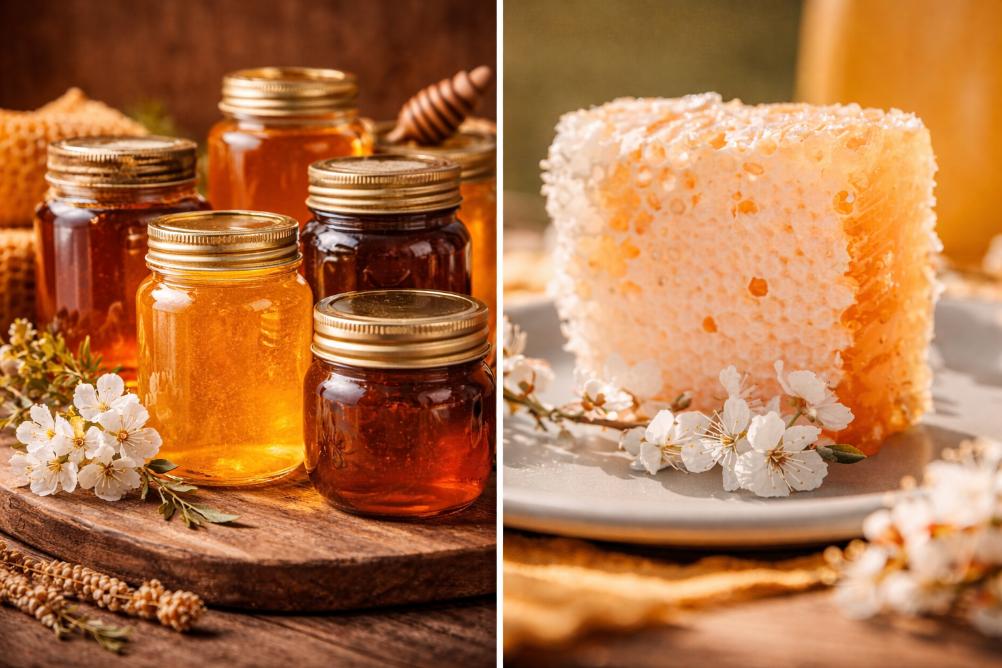
Today, honey is appreciated not only as a food but also as a fascinating product of bee biology and ecology. The floral source of nectar, regional climate, and even soil conditions can influence the characteristics of each honey, creating a remarkable diversity of honey varieties around the world.
In this guide you’ll learn:
- How bees transform nectar into honey.
- What are the main types of honey, varieties of honey, and how they differ.
- What shapes honey’s colour, flavour, and texture.
- How experts evaluate honey quality.
- Nutritional value and health properties of honey.
- Practical ways to use honey in food.
- How to choose good honey.
- How to continue exploring the remarkable diversity of honey through the Honey Library.
Start Here
If you’re new to all that is related to honey, start here — these essential guides explain the most important aspects clearly and simply:
| Guide | What you’ll learn |
|---|---|
| Types of Honey | Nectar & honeydew, mono- and multifloral honey, different varieties. |
| Honey Texture & Taste | Why honeys vary in flavour, colour, and texture. |
| Honey Crystallisation | Why honey crystallises, how to fix it, and what it really says about quality. |
| Honey Benefits | Nutritional value, traditional uses, and practical applications. |
| Honey Ratings | How experts evaluate honey quality and grading systems. |
| Choosing Good Honey | How to recognise authentic honey and avoid common mistakes. |
What Is Honey?
Honey is a natural sweet substance produced by honey bees from the nectar of flowers or from other plant-derived sugars such as honeydew. The bees transform these sugars through enzymatic activity and evaporation, producing a concentrated, stable food that can be stored for long periods within the hive.
Most honey consumed worldwide is produced by the Western honey bee.
I. How Do Bees Make Honey?
The process begins when forager bees collect nectar from flowering plants. Nectar is primarily a dilute sugar solution containing sucrose, glucose, fructose, water, and trace compounds that contribute to the plant’s aroma.
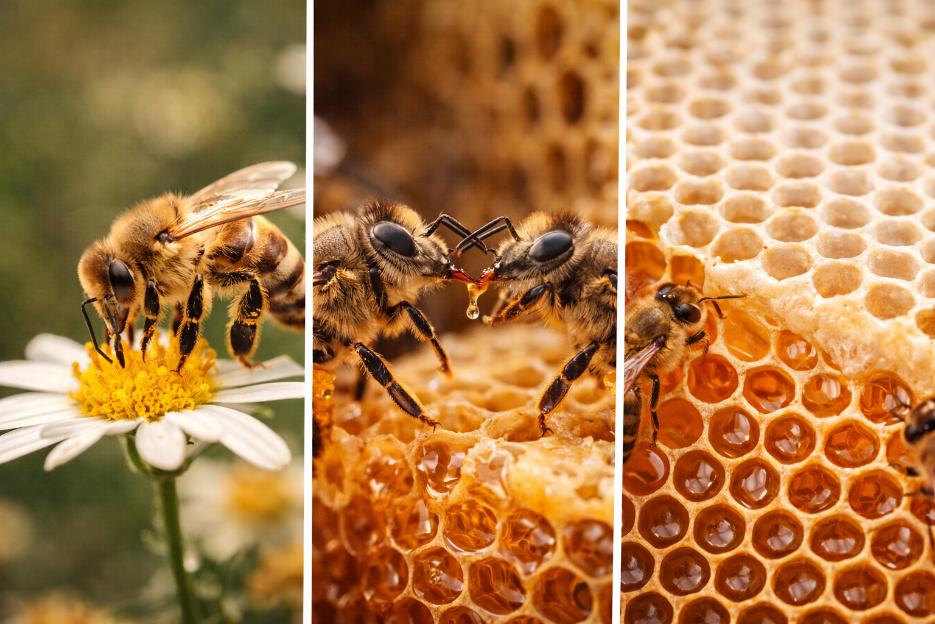
Inside the bee’s honey stomach, enzymes begin transforming the nectar. When the forager returns to the hive, the nectar is passed to house bees, which continue processing it and deposit it into wax cells.
Bees then fan their wings to circulate air through the hive, gradually evaporating water from the nectar. As the water content drops, the liquid thickens and becomes stable honey.
Curious how different flowers create such different honeys? Explore our Blossom Honey guide to discover how nectar sources shape flavour, aroma and colour.
Why Bees Store Honey
For the colony, honey is not a luxury but a vital survival resource. It provides the energy needed to sustain the bees during:
- periods of poor weather,
- winter months when flowers are unavailable,
- times when brood production requires increased energy.
In this way, honey functions as the colony’s long-term energy reserve.
II. What are the Main Types of Honey?
Honey can be classified in several ways. The most practical and simple classifications are based on:
- the source of sugars collected by bees,
- the floral composition of the nectar.
Based on these criteria, honey can be grouped into the following main types.
I. Classification by Source of Sugars
This is the most fundamental distinction.
- Nectar (blossom) honey
Produced when bees collect nectar from flowering plants. This is the most common type of honey worldwide. - Honeydew honey
Produced when bees collect sugary secretions known as honeydew from insects that feed on plant sap, usually on trees.
II. Classification by Floral Composition (subcategory of Blossom Honey Type)
Blossom honeys are often further classified according to the variety of flowers contributing nectar.
- Monofloral honey
Produced when nectar from one plant species predominates in the honey. These honeys are usually named after the dominant flower, such as acacia, lavender, or chestnut honey. - Multifloral honey (polyfloral or wildflower honey)
Produced from nectar collected from many different flowering plants within the same landscape.
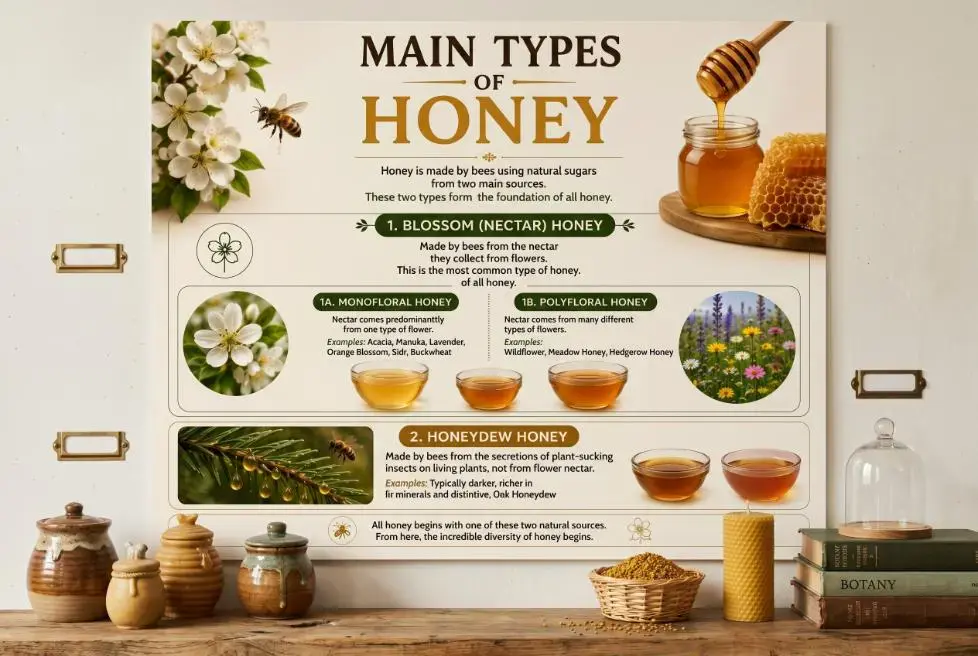
Once you understand the two main types of honey, discover the remarkable diversity found within Blossom Honey, where hundreds of individual honey varieties begin.
Mixed Nectar–Honeydew Honeys
In nature, bees may collect both nectar and honeydew within the same landscape. When this happens, the resulting honey is often described as mixed-origin honey or nectar–honeydew honey.
In practice, many honeys fall somewhere between these two sources. In such cases, the honey is usually classified according to the dominant source of sugars, although mixed nectar–honeydew honeys are relatively common in forested or diverse ecosystems.
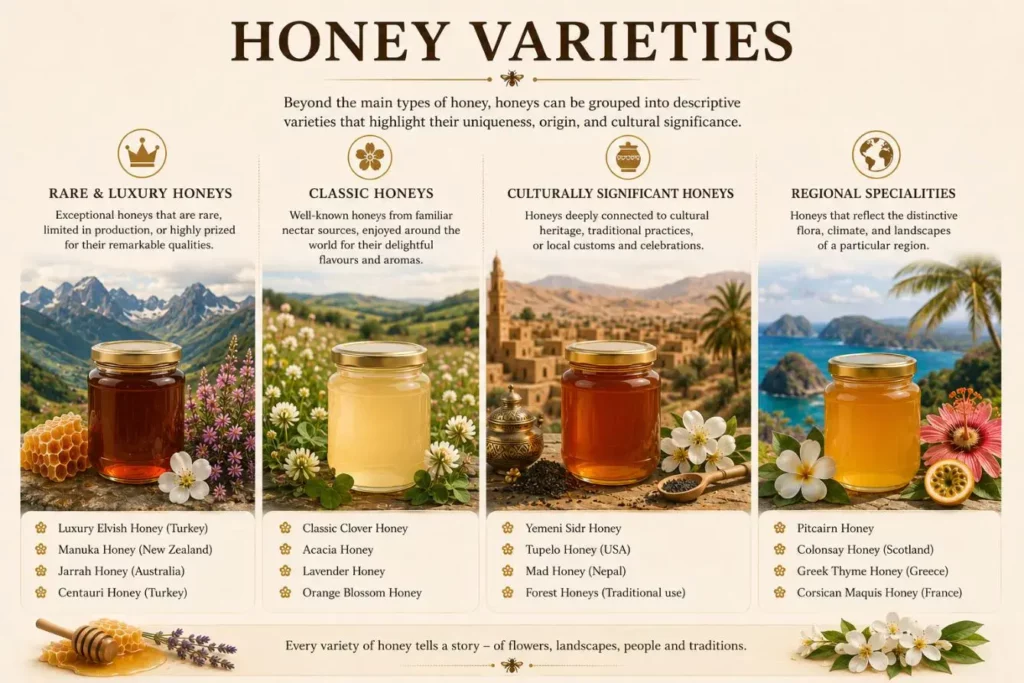
What Is A Honey Variety?
Beyond these structural classifications, honey is sometimes grouped into descriptive categories such as:
- rare and luxury honeys,
- regional specialties, and so on.
These categories are not scientific classifications but help describe honeys that are unusual, limited in production, culturally significant, or originating from a specific geographic area.
Some honeys are so strongly associated with particular places, such as Sidr honey from Yemen or Manuka honey from New Zealand, that they are often called regional specialities.
Also, depending on the region where honey is produced, it can be described as single-origin (in other words, from one specific area or region) or blended (meaning: from multiple regions or countries, usually blended in order to achieve a consistent flavour and colour, very typical of “commercial/ supermarket” honey).
Honey Classification Overview
Honey is rarely described using just one term. A single honey may simultaneously be classified by:
- its main type (blossom or honeydew),
- its floral composition (monofloral or polyfloral),
- and its variety based on its origin, rarity, regional identity, etc.
For example, Yemeni Sidr honey is a blossom honey, monofloral, single-origin, and also considered one of the world’s best-known premium honey varieties.
Understanding how these descriptions overlap helps explain why honey is such a remarkably diverse natural product.
To explore these classifications in more detail, see our complete guide to Types of Honey.
III. Why Does Honey Differ in Colour, Texture, and Flavour?
Few natural foods display as wide a sensory spectrum as honey. Two jars may look similar at first glance yet reveal completely different aromas and flavours when tasted.
These differences in honey texture and flavour arise primarily from the nectar source, though environmental factors also play a role.
Honey Colour Spectrum
Honey ranges from almost colourless to deep amber and dark brown.
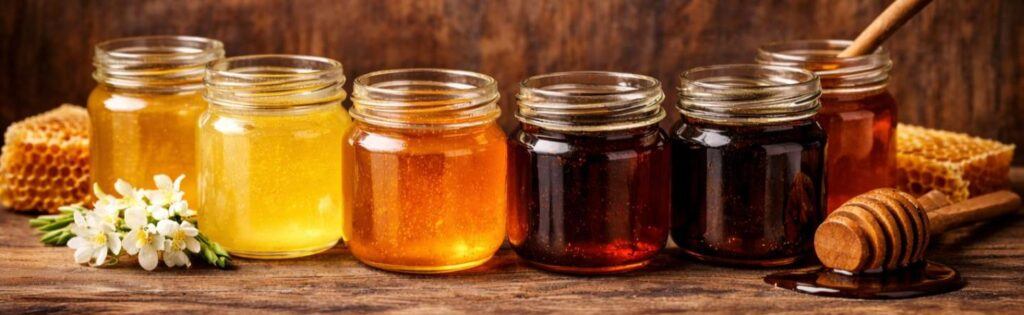
In general:
- light honeys tend to have delicate, mild flavours;
- amber honeys display more pronounced sweetness and aroma;
- dark honeys often have stronger, more robust flavours.
The colour is influenced by the minerals, pollen, and plant compounds present in the nectar.
Honey Texture and Crystallisation
Honey may appear liquid, creamy, or crystallised depending on its sugar composition.
Why Does Honey Crystallise? (click here for more details)
Honey crystallises because it contains natural sugars, mainly glucose and fructose. When glucose separates from the liquid and forms tiny crystals, the honey gradually becomes solid or creamy. This is a natural process and does not mean the honey has spoiled.
The tendency to crystallise is influenced mainly by the ratio of glucose to fructose. Honeys high in glucose crystallise faster, while those richer in fructose (such as, tupelo honey) remain liquid longer.
Temperature also affects crystallisation. Cooler conditions generally accelerate the process.
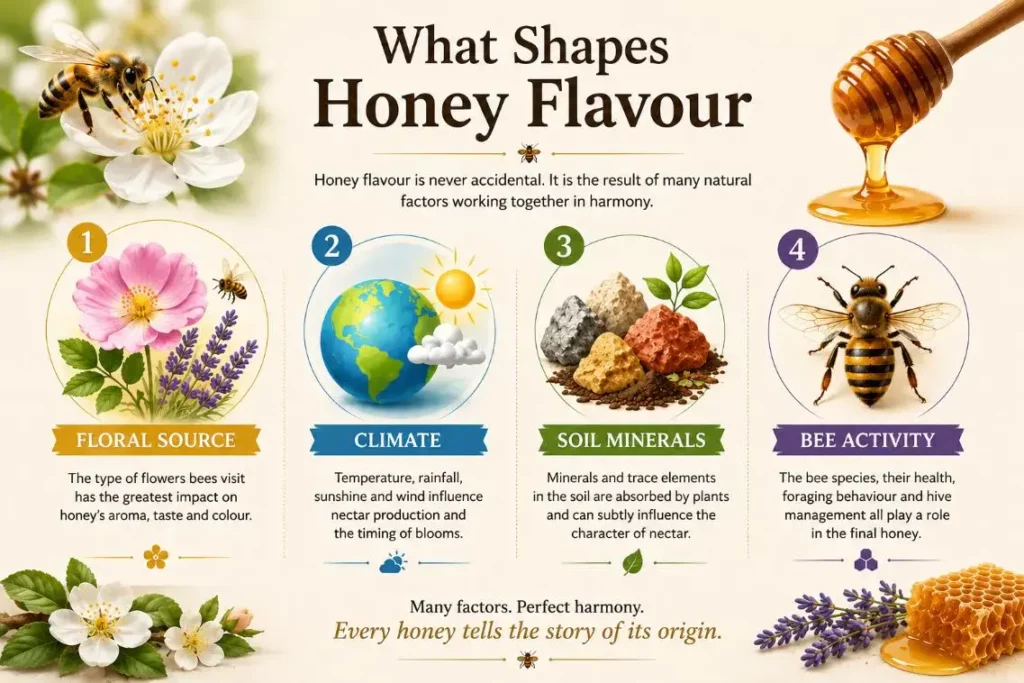
The Influence of Floral Source on Taste
The flavour of honey ultimately reflects the plants visited by bees. Each flower contributes unique aromatic compounds that shape the honey’s character.
Climate, soil composition, and regional ecosystems further influence these flavours, which is why honeys from different regions can be surprisingly distinctive.
Want to explore these flavours in real honeys? Visit the Blossom Honey Library to discover classic, regional, luxury and unusual blossom honeys from around the world.
IV. How Is Honey Quality Evaluated?
Not all honey is the same. Quality can vary depending on harvesting methods, processing, and storage.
Professional evaluation of honey typically considers several factors.
Key Indicators of Honey Quality
Experts assess several honey quality indicators, the most important including:
- moisture content,
- purity and absence of adulteration,
- floral authenticity,
- aroma and flavour.
These elements help determine whether honey reflects its true botanical origin and whether it has been properly handled.
Common Misconceptions About Honey Quality
Several widely held beliefs about honey are misleading.
For example:
- crystallised honey is often mistakenly thought to be spoiled, yet crystallisation is a natural process;
- darker honey is sometimes assumed to be inferior, though many dark honeys are highly prized.
Understanding these points helps consumers evaluate honey more confidently.
V. Nutritional Value and Health Properties of Honey
Honey contains a mixture of natural sugars, small amounts of organic acids, minerals, enzymes, and plant-derived compounds. While it is primarily a carbohydrate source, these additional components contribute to its nutritional profile.
Honey as a Natural Energy Source
Because it contains simple sugars that are easily absorbed, honey provides a rapid source of energy. For this reason it has traditionally been used by travellers, labourers, and athletes seeking quick nourishment.
Traditional Uses of Honey
Throughout history, honey has been valued in many cultures for both culinary and medicinal purposes. It has been used to soothe the throat, incorporated into herbal preparations, and appreciated as a natural preservative. These traditional uses reflect a long-standing recognition of honey’s distinctive nutritional and therapeutic qualities.
Today, scientific research continues to investigate the health benefits of honey, offering deeper insight into the properties that have made it valued for centuries.
VI. Culinary Uses of Honey
Beyond its nutritional role, honey is prized for the flavour and aroma it brings to food.
Sweetening Naturally with Honey
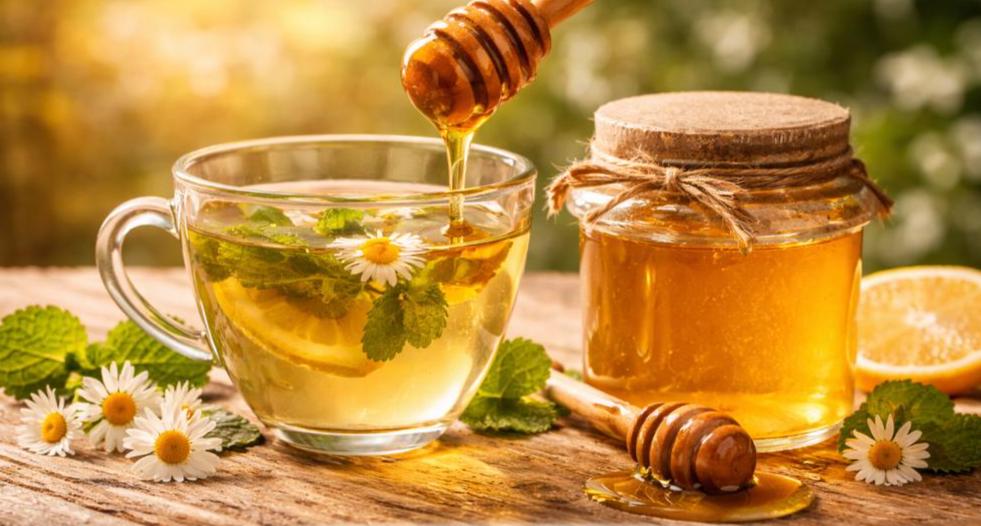
Honey is widely used as a sweetener in beverages such as:
- tea,
- coffee,
- herbal infusions.
Its flavour can subtly influence the taste of the drink, especially when lighter honeys are used.
Cooking and Baking with Honey
Honey performs particularly well in baking because it helps retain moisture. It can also contribute to browning through caramelisation, producing rich flavours in baked goods.
In savoury cooking, honey is often used in:
- salad dressings,
- marinades,
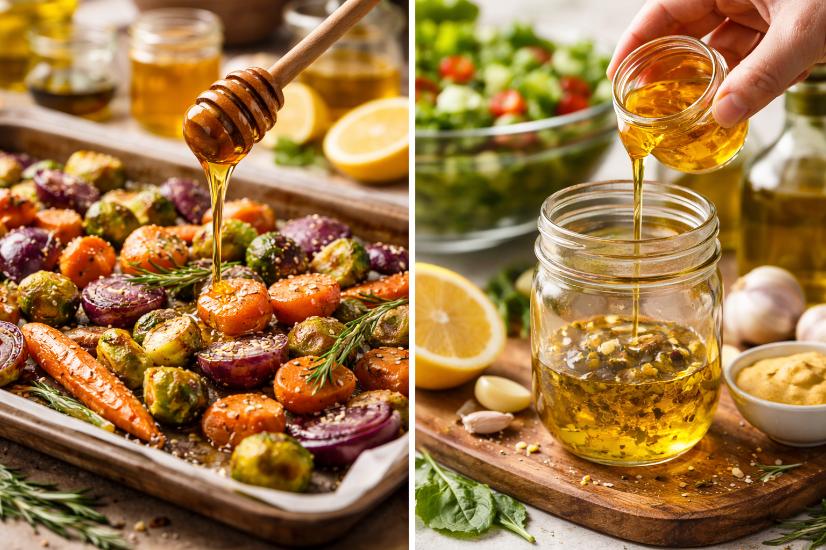
- glazes for roasted vegetables or meats.
Pairing Honey with Foods
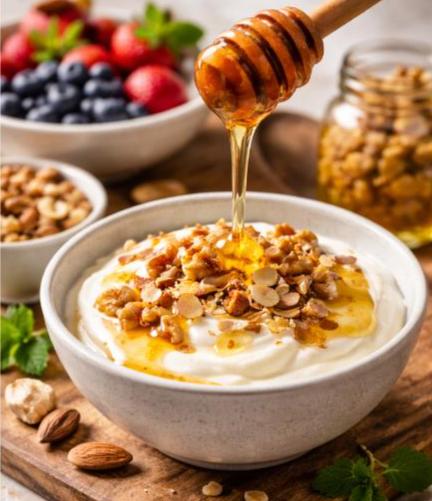
Honey pairs well with many foods, especially those that balance its sweetness.
Popular combinations include:
- roasted vegetables finished with a drizzle of honey,
- cheese and honey,
- yoghurt with honey and nuts.
Different honey types can produce very different pairing experiences, making honey an interesting ingredient for culinary exploration.
VII. How to Choose Good Honey?
Selecting quality honey involves paying attention to several practical details.
You may consider the following:
- whether the honey is raw or processed;
- the country or region of origin;
- clarity of labelling;
- natural crystallisation patterns.
Understanding labels, origin, and processing methods can help consumers learn how to choose the best honey.
Many of the world’s finest honeys are featured throughout our Honey Library, where you’ll discover what makes each variety distinctive.
Frequently Asked Questions About Honey
Does honey expire?
Honey does not expire when stored properly. Because it contains very little water and has natural antimicrobial properties, honey can remain stable for many years. Over time it may darken or crystallise, but these changes do not mean the honey has spoiled.
Why do some honeys stay liquid longer than others?
The tendency of honey to remain liquid depends mainly on its natural sugar composition. Honeys that contain more fructose than glucose tend to crystallise more slowly. Some varieties, such as Acacia honey and Tupelo honey, are well known for staying liquid for long periods.
VIII. Exploring the World of Honey
If you are interested in exploring honey more deeply, the next step is understanding the remarkable diversity found within the world of honey types.
Although all honey begins as either blossom or honeydew honey, different floral sources, landscapes, climates, and regional traditions create an extraordinary range of honey varieties with unique flavours, aromas, textures, colours, and stories.
Now that you understand how honey is made and why every jar is different, continue exploring the Honey Library:
Choosing Good Honey — recognise authentic, high-quality honey with confidence.
Types of Honey — understand the two main types and how honey is classified.
Blossom Honey — discover the extraordinary diversity of nectar honeys from around the world.
Honeydew Honey — explore the darker, forest-derived honeys produced from honeydew rather than nectar.
Honey Texture & Taste — learn why colour, flavour and texture vary so much.