Among the world’s rarest and most scientifically celebrated honeys, Manuka honey stands as a benchmark for both taste and therapeutic potency. Produced from the nectar of the Leptospermum scoparium (Manuka) bush in New Zealand, it has gained international acclaim for its unique antibacterial properties, high MGO content, and exceptional UMF certification standards.
While everyday Manuka honey is prized, the UMF 32+ and 35+ grades represent the pinnacle of natural potency — a true “grand cru” in the honey world.
What Makes Manuka Honey So Exceptional?
Manuka honey’s power comes from its methylglyoxal (MGO) content, which provides non-peroxide antibacterial activity.
Unlike most honeys, its strength is not solely dependent on hydrogen peroxide, meaning it retains antibacterial potency even when exposed to light or warmth.
The UMF™ Honey Association rigorously tests every batch, confirming authenticity and measuring compounds like MGO, DHA (dihydroxyacetone), and leptosperin, the markers of genuine Manuka honey.
Only honey meeting the UMF grading standard is allowed to carry the trademarked UMF label.
Why DHA Matters in Manuka Honey
DHA itself is not strongly antibacterial. However, it is the precursor to MGO (methylglyoxal) — the key compound responsible for Manuka honey’s powerful non-peroxide antibacterial activity.
Over time, DHA gradually converts into MGO during honey maturation.
The Process Simplified:
Manuka flower nectar contains high levels of DHA. → Bees convert nectar into honey. → During storage and maturation, DHA converts into MGO. → Higher MGO = stronger antibacterial potency.
Why Labs Measure DHA
Certified Manuka honey is tested for:
- MGO (current antibacterial strength)
- DHA (future potential MGO)
- Leptosperin (marker confirming genuine Manuka origin)
High DHA indicates that the honey may continue to develop higher MGO levels over time — if stored properly.
A Little-Known Insight
Freshly harvested Manuka honey can test lower in MGO but higher in DHA.
After months of maturation, MGO levels may increase significantly as DHA converts.
This is why some producers age high-grade Manuka honey before release.
Important Clarification
DHA in honey is not the same as the DHA omega-3 fatty acid found in fish oil.
They are completely different compounds.
UMF 35+ honey is exceedingly rare. Each batch must exceed approximately 1700 mg/kg of MGO, with production limited to just a few hundred kilograms worldwide per year due to environmental dependencies:
- Short flowering season: Manuka blooms for only a few weeks each summer.
- Climate-sensitive nectar: Temperature, rainfall, and nectar flow affect the yield.
- Strict quality control: Only honey passing rigorous laboratory testing receives UMF certification.
This combination of scarcity, potency, and certification makes UMF 35+ a true “scientific rarity” — celebrated as the grand cru of honeys.
To taste UMF 32+ and 35+ Manuka honey is to experience the pinnacle of medicinal honey. It represents the rarest, most potent batches tested and certified by the UMF™ Honey Association.
👉 Explore our full guide: Rare & Luxury Honey Of The World to discover how Manuka compares with other premium honeys worldwide.
Flavour Profile and Appearance
Manuka honey is instantly recognisable:
- Colour: Dark amber to rich golden brown
- Aroma: Earthy, slightly woody, and herbaceous
- Taste: Bold, complex, slightly bitter with a lingering caramel-like sweetness
- Texture: Thick, creamy, and luxurious
Unlike mild floral honeys, Manuka’s flavour is distinctive and unmistakable, and high-grade UMF 35+ honey offers a more intense and concentrated taste that reflects its potency.
Comparing Different UMF Grades: My Experience
To better understand how UMF levels differ in practice, I compared three jars: UMF 5+, UMF 15+, and UMF 25+.
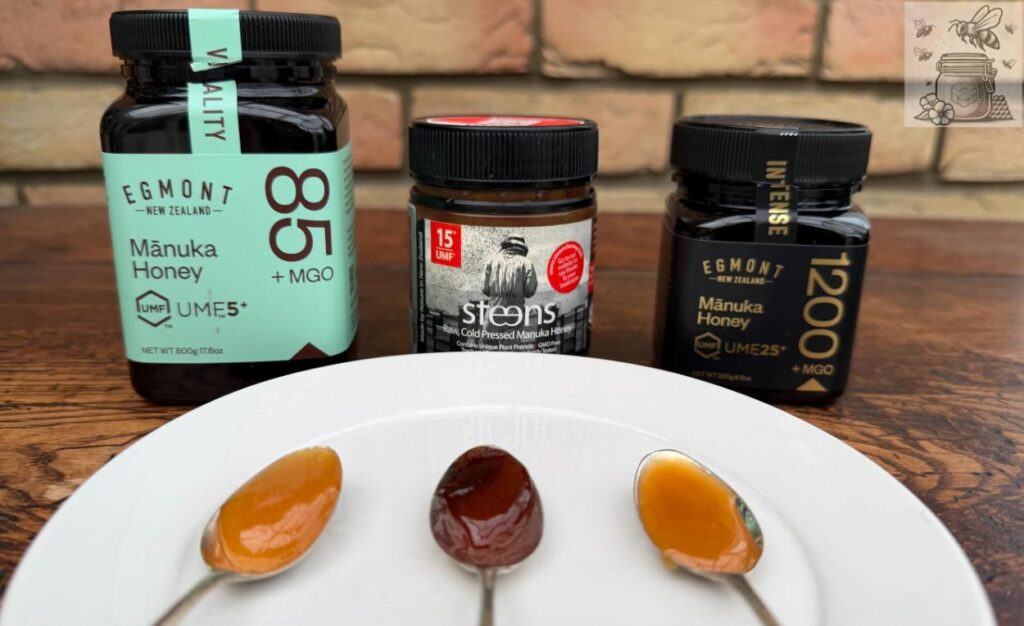
- UMF 5+ is mild and pleasant, well suited for everyday use in tea, yogurt, or as a natural sweetener. The flavour is smooth and lovely.
- UMF 15+ has noticeably stronger character — richer (in fact, I know that for some people the taste is too rich), more medicinal, with a pleasant bitter note, and often chosen for consistent daily wellness support.
- UMF 25+ is significantly more concentrated but the texture is so very silky smooth. The flavour becomes deeper, more complex, slightly earthy and herbal, reflecting its higher bioactive potency. This grade feels very luxurious and more suited as a special treat (or for targeted use) rather than casual sweetening.
Tasting them side by side makes the grading system much easier to understand — higher UMF levels are not just numbers on a label; they influence intensity, texture, and intended purpose.
I would definitely recommend trying at least two different grades to compare. The taste of Manuka honey is unmistakable — bold, slightly herbal, and uniquely complex — yet very pleasant. After sampling several jars, I’m confident I would recognise authentic Manuka even without seeing the label.
Health Benefits of Manuka Honey
Scientific research and traditional use converge in Manuka honey’s health-promoting qualities. The benefits include:
- Powerful antibacterial and antimicrobial activity — effective against bacteria such as Staphylococcus aureus and H. pylori.
- Wound healing and skin support — promotes tissue repair, reduces infection, and maintains moisture.
- Oral health aid — inhibits bacterial growth in the mouth, supporting gum health.
- Digestive support — helps regulate gut flora and soothes minor digestive discomforts.
- Immune support — boosts natural defenses through bioactive compounds.
- Anti-inflammatory properties — reduces redness, swelling, and irritation topically or internally.
High UMF levels (32+, 35+) amplify these effects, making these honeys particularly valued in therapeutic applications and wellness routines.
A Honey with History and Prestige
Manuka honey has a rich cultural and scientific history:
- Indigenous Māori knowledge: For centuries, Māori people used Manuka plants and honey for wound care, digestive issues, and general wellbeing.
- Modern research: Studies from New Zealand and international labs confirm its antibacterial properties and medicinal applications.
- Global recognition: High UMF Manuka honey is now sought after worldwide, often commanding premium prices due to its limited supply and clinical potency.
The highest grades, such as UMF 32+ and 35+, are considered luxury, rare “vintage” honeys — a symbol of both scientific validation and natural exclusivity.
Little-Known Facts About Manuka Honey
- Not all Manuka honey is created equal — UMF certification is the only guaranteed way to verify authenticity.
- MGO levels increase with age — freshly harvested honey may mature to higher potency after storage.
- UMF 35+ honey is extremely rare — global production can be less than 500 kg per year.
- Environmental factors matter — rain, temperature, and even soil quality influence nectar composition.
- Therapeutic-grade honey is tested multiple times — both at harvest and before packaging.
- Topical vs. internal use — high UMF honey is ideal for wound care, while moderate grades support daily wellness.
- Manuka honey can be used in skincare — its antimicrobial and humectant properties make it perfect for DIY masks and salves.
- It crystallises slowly — high MGO slows natural granulation, keeping the honey smooth longer.
- “Grand cru” terminology — the rarest UMF grades are often called the finest or most collectible honey, similar to premium wine.
- Manuka honey is traceable — each certified jar has a batch number for lab verification.
How to Enjoy Manuka Honey
High-grade Manuka honey isn’t just for medicinal use — it’s also a luxurious addition to everyday meals:
- Drizzle over warm porridge, pancakes, or Greek yogurt
- Stir into herbal teas (after the water cools slightly to preserve enzymes)
- Blend into smoothies for immune support
- Apply a thin layer to minor cuts, burns, or blemishes for topical healing
- Use in homemade face masks as a natural humectant and antibacterial
- Enjoy a spoonful daily for digestive and immune support
UMF 32+ or 35+ honey is particularly well-suited to these uses, offering intense flavour and maximum bioactivity.
Understanding UMF Ratings and MGO Levels
The UMF™ Honey Association guarantees authenticity, traceability, and lab-tested MGO content, making it the gold standard for Manuka honey.
Understanding Manuka honey’s UMF rating, MGO content, and DHA levels is essential if you want to choose an authentic, high-quality product.
With so many numbers and grading systems on labels — from UMF and MGO to activity ratings and laboratory certifications — it’s easy to feel overwhelmed.
If you’d like a clear, in-depth breakdown of how honey grading works and how to evaluate quality with confidence, read our comprehensive guide: Best Honey Ratings & Quality Indicators Explained. It will help you interpret labels correctly and make informed purchasing decisions across all premium honey varieties.
Manuka Honey FAQ
Is Manuka honey from New Zealand or Australia?
Manuka honey is most strongly associated with New Zealand, where the Manuka bush (Leptospermum scoparium) is native and widely distributed. The internationally recognised UMF™ grading system is also based in New Zealand, and many of the highest certified UMF grades (such as 32+ and 35+) are produced there.
However, Manuka plants and closely related Leptospermum species also grow naturally in parts of Australia, and Australian producers harvest and market Manuka honey as well. Today, both countries produce genuine Manuka honey, though labeling standards and certification systems may differ.
For consumers, the key factor is not just the country of origin, but verified laboratory testing, traceability, and recognised certification (such as UMF™ or equivalent standards).
What is UMF in Manuka honey?
UMF (Unique Manuka Factor) is a certification that measures non-peroxide antibacterial activity.
How does UMF relate to MGO?
MGO (methylglyoxal) is the main antibacterial compound. UMF rating accounts for MGO, DHA, and leptosperin to ensure authenticity.
Is UMF 35+ worth it?
Yes — it represents the highest certified potency, suitable for advanced therapeutic or topical applications.
How rare is UMF 35+ honey?
Extremely rare — only a few hundred kilograms are produced globally per year due to short flowering seasons and environmental limits.
Can I use it for wounds?
Yes, high UMF Manuka honey is clinically validated for wound care, burns, and skin infections.
How should I store Manuka honey?
Keep it sealed in a cool, dark place. Avoid excessive heat to preserve bioactive compounds.
Can children consume Manuka honey?
Yes, but like all honeys, it should not be given to infants under 12 months.
Does UMF 35+ taste different?
Yes — it has a more concentrated, complex, slightly bitter and earthy flavour compared to lower grades.
How can I verify authenticity?
Look for the UMF™ trademark and batch number, and purchase from trusted suppliers.
Can it be used in skincare?
Absolutely — its antimicrobial and humectant properties make it ideal for DIY masks, salves, or topical treatments.
Does heating destroy its potency?
High heat can degrade enzymes and MGO, so it’s best added to warm foods or taken raw.