
A curated look at one of the world’s most talked-about ultra-rare honeys.
What Is Elvish Honey?
Elvish Honey, known locally as Peri Balı (“Fairy Honey”), is a Turkish honey reportedly harvested from a cave system in the Artvin province of northeastern Turkey, near the Black Sea region.
It is frequently described as:
- Cave-origin honey
- Harvested from deep rock formations
- Produced in very limited annual quantities
- Dark, mineral-rich in character
- Positioned in the ultra-luxury food market
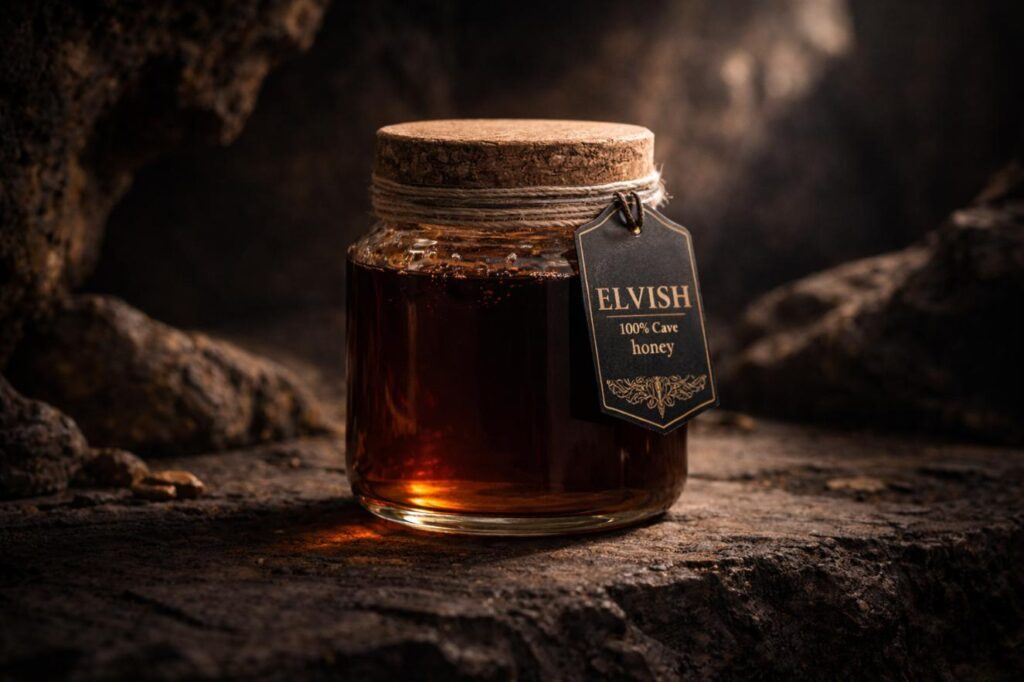
Public sources state that Elvish Honey was discovered in a cave at significant depth (often reported around 1,800 metres above sea level in mountainous terrain). However, detailed independently published documentation of the exact harvesting protocol remains limited.
As with other ultra-rare honeys, part of its intrigue stems from narrative as much as from chemistry.
Cave Harvesting & Beekeeping Practices
Elvish Honey is widely associated with honey found within cave environments rather than in conventional apiaries.
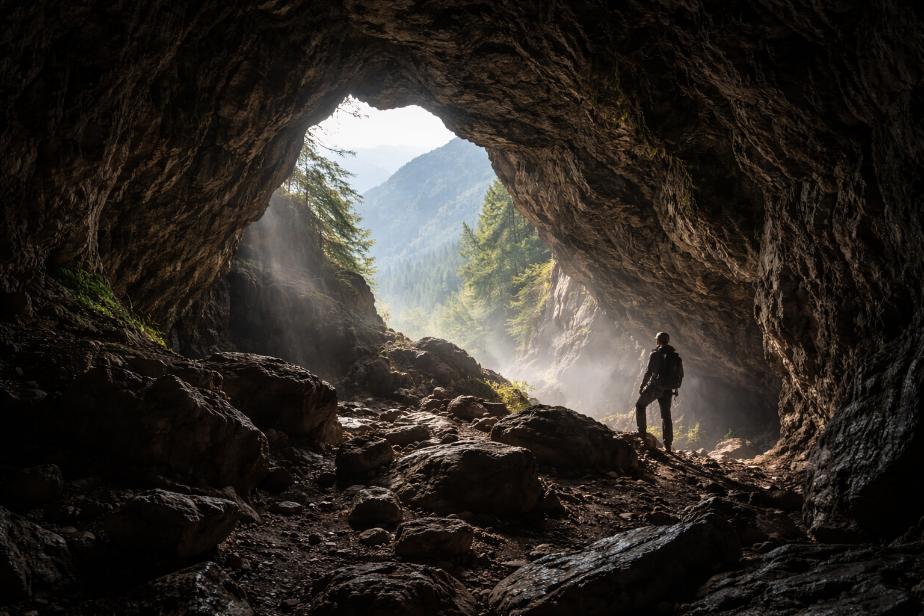
According to producer accounts:
- The honey is accessed via professional climbers
- The cave interior provides stable temperature and humidity
- Natural rock cavities act as honey storage chambers
However, there is very limited publicly available technical documentation describing:
- The specific bee species involved
- Whether managed hives are placed nearby
- The degree of beekeeper intervention.
Unlike conventional beekeeping, where movable-frame hives are clearly visible and traceable, Elvish Honey is positioned as a naturally accumulated cave honey. The extent of human management versus wild colony activity is not extensively documented in independent academic literature.
This ambiguity contributes to both fascination and debate.
Why Is Elvish Honey So Expensive?
Elvish Honey gained global attention when it was reportedly sold at Harrods in London for approximately £1,250 per 200 grams.
Several factors contribute to its pricing:
- Extremely limited reported annual harvest (often cited around 20 kg per year)
- High labour intensity and technical access challenges
- Luxury positioning within gourmet markets
- Narrative uniqueness (cave origin story)
Unlike Centauri Honey, Elvish Honey does not hold a Guinness World Record. However, it has been marketed as one of the most expensive honeys ever commercially retailed.
As with other ultra-luxury foods, scarcity and branding significantly influence pricing.
Elvish Honey is featured in our Rare & Luxury Honeys of the World collection, which explores honeys distinguished by extreme scarcity, production difficulty, or exceptional market positioning.
Global Demand & Market Positioning
Producer statements suggest that Elvish Honey is sold primarily through exclusive channels rather than mass distribution.
It is often described as:
- Limited edition
- Collector-oriented
- Targeted at luxury food enthusiasts
However, independently verifiable public data regarding annual export volumes, buyer demographics, or long-term waiting lists is not widely published.
As with Centauri, references to elite clientele should be understood within the context of luxury brand positioning rather than documented procurement records.
Laboratory Testing & Composition
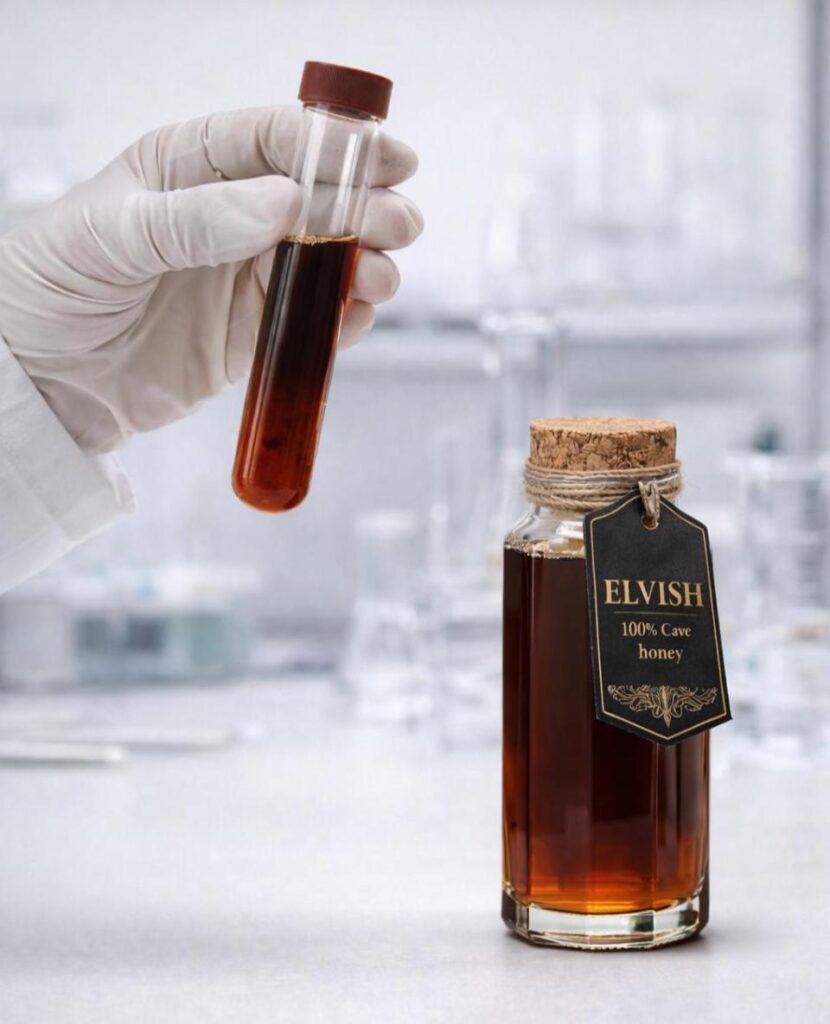
Suppliers indicate that Elvish honey undergoes laboratory testing prior to sale to assess:
- Mineral content
- Moisture levels
- Chemical composition
However, unlike certified medical-grade honeys such as high-UMF Manuka (which publish standardised methylglyoxal levels under a regulated framework), Elvish honey does not operate under an internationally standardised potency certification system.
Publicly available peer-reviewed scientific studies specifically analysing Elvish honey remain limited.
Taste Profile
Descriptions from retailers and tasters frequently note:
- Dark amber to deep brown colour
- Thick, dense texture
- Mineral-forward character
- Slight bitterness
- Less overt sweetness compared to floral honeys
Because verified independent tasting panels are scarce, flavour descriptions largely originate from supplier material and specialty retailers.
Elvish vs Centauri: What’s the Difference?
Given that both honeys are:
- Turkish
- Cave-associated
- Extremely expensive
- Limited in quantity
They are often confused.
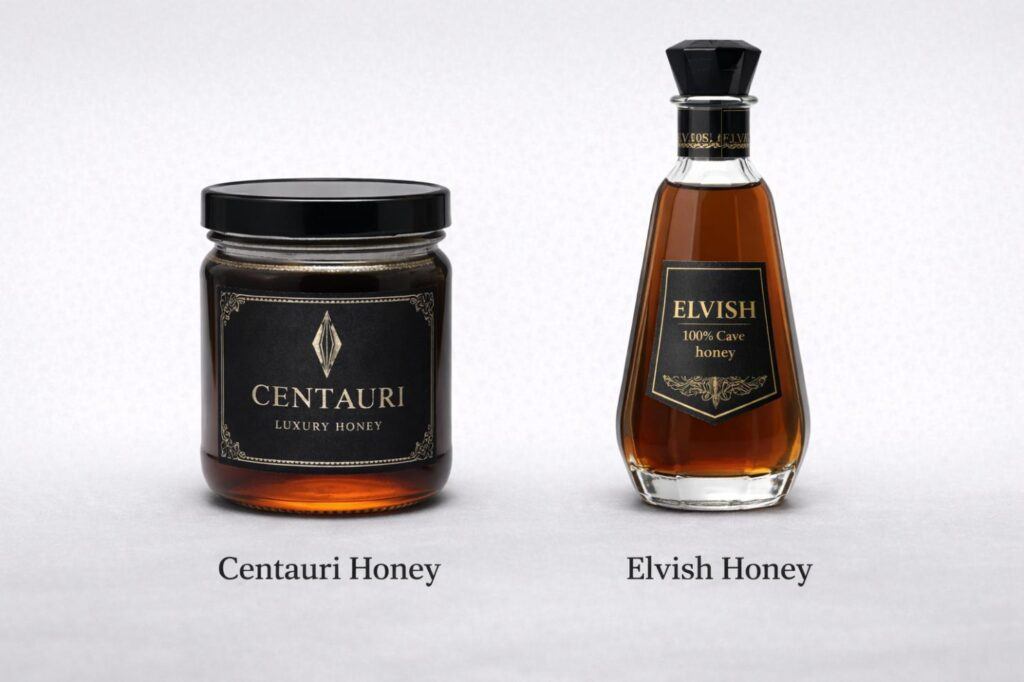
Key distinction:
- Centauri Honey holds a Guinness World Record for highest reported sale price.
- Elvish Honey gained attention through retail positioning at Harrods and its limited annual harvest claims.
Both are marketed within the ultra-luxury niche, but their branding narratives differ.
| Feature | Centauri Honey | Elvish Honey (Peri Balı) |
| Country | Turkey (Artvin region) | Turkey (Artvin region) |
| Harvest Narrative | Associated with high-altitude cave discovery | Associated with cave harvesting |
| Record Recognition | Guinness World Record (2021) for highest reported sale price | No Guinness record |
| Reported Price | ~€10,000/kg (record sale) | ~£1,250 per 200g (luxury retail) |
| Annual Production | Extremely limited (exact figures not publicly audited) | Often cited ~20 kg/year |
| Certification Framework | No standardised medical certification system | No standardised medical certification system |
| Market Position | Ultra-luxury, record-setting | Luxury retail exclusivity |
| Scientific Publications | Limited publicly available peer-reviewed data | Limited publicly available peer-reviewed data |
Health Claims: What Is Known?
As with many rare honeys, Elvish Honey is sometimes associated with:
- High mineral content
- Antioxidant properties
- Traditional wellness uses
However:
- There is no widely recognised medical-grade certification framework for Elvish Honey.
- Peer-reviewed clinical studies specific to this honey are limited.
Consumers should approach medicinal claims cautiously and rely on verified laboratory data where available.
Is Elvish Honey Truly “Worth It”?
Whether Elvish Honey justifies its price depends on what the buyer values:
- Chemistry and documented therapeutic potency?
- Extreme scarcity?
- Narrative uniqueness?
- Collectibility?
Like rare wines or single-origin coffees, part of its value lies in rarity and story rather than purely nutritional metrics.
Final Thoughts: Rarity Beyond the Jar
Elvish Honey occupies a fascinating space in the world of ultra-rare foods. It exists at the intersection of geology, storytelling, and luxury positioning.
Its value does not stem from a universally recognised medicinal certification framework, nor from mass-market demand. Instead, it reflects scarcity, narrative distinction, and the allure of something that few people will ever taste.
In the broader landscape of Rare & Luxury Honeys of the World, Elvish Honey stands not merely as a sweetener — but as a symbol of how rarity, place, and perception can transform honey into an object of prestige.
For some, that prestige justifies the price.
For others, the intrigue alone is enough.
Related Rare Honeys
Explore Other Rare & Luxury Honeys:
• Centauri Honey – Guinness record-holder
• Sidr Honey – Sacred Yemeni monofloral
• Manuka UMF 35+ – Scientifically graded potency
Frequently Asked Questions About Elvish Honey
Is Elvish Honey really harvested from a cave?
Producer sources state that Elvish Honey is harvested from a cave system in northeastern Turkey. However, independently published technical documentation detailing the exact harvesting conditions and level of beekeeper management is limited.
How much does Elvish Honey cost?
Retail reports have cited prices around £1,250 for 200 grams in luxury outlets. Pricing varies by batch and availability, as production is described as extremely limited.
How much Elvish Honey is produced each year?
Supplier statements frequently reference an annual harvest of approximately 20 kilograms. Publicly verified production audits are not widely available.
Is Elvish Honey medically certified?
Unlike high-UMF Manuka honey, Elvish Honey does not operate under an internationally standardised potency certification system. Laboratory testing is reportedly conducted by suppliers, but peer-reviewed clinical studies specific to this honey remain limited.
What does Elvish Honey taste like?
It is typically described as dark, dense, and mineral-forward, with a lower perceived sweetness compared to floral honeys.
Is Elvish Honey the same as Centauri Honey?
No. While both are Turkish and associated with cave narratives, Centauri Honey holds a Guinness World Record for its reported sale price. Elvish Honey gained prominence through luxury retail positioning and limited annual harvest claims.