
Few honeys have generated as much intrigue — and as many headlines — as Centauri honey. Marketed as one of the most expensive honeys ever sold, it entered global conversation after being recognised by Guinness World Records in 2021 for its extraordinary price per kilogram.
- But what exactly is Centauri honey?
- Is it truly harvested from caves?
- Why does it command such exceptional prices?
- And does rarity equal measurable quality?
In this guide, we examine Centauri honey carefully — separating documented fact, producer narrative, and scientific transparency.
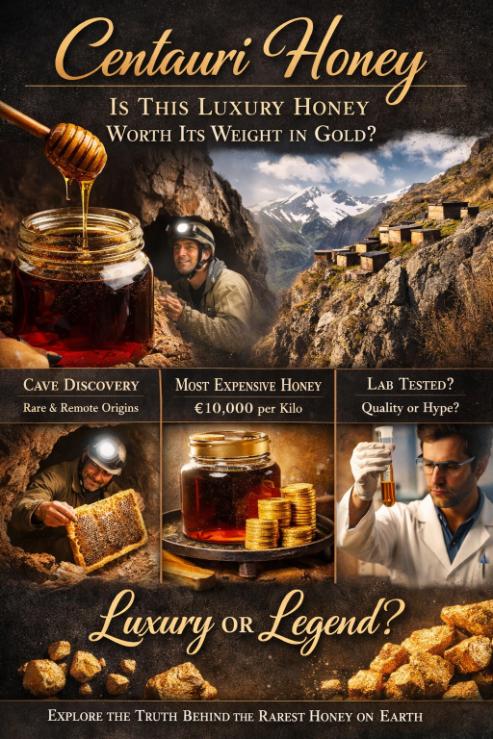
What Is Centauri Honey?

Centauri honey is a high-value Turkish honey associated with the Artvin region in northeastern Turkey, near the Black Sea.
It is typically described as:
- Wild-harvested
- Produced in extremely limited quantities
- Sourced from remote mountainous terrain
- Dark, dense, and mineral-rich in character
Media coverage frequently references a dramatic discovery story involving honey found deep within a cave. This narrative played a significant role in its rise to global attention.
However, publicly available documentation about the precise harvesting conditions and beekeeping practices remains limited and varies between sources. Producer accounts describe colonies located in remote, high-altitude areas, isolated from other apiaries and human settlements. This isolation is presented as a way of protecting hive health and preserving ecological purity.
While Centauri honey is often associated with cave-origin descriptions, independently verified technical details about the exact extraction environment — whether natural cave formations or managed high-altitude colonies — are not widely published in scientific or apicultural literature.
This combination of geographic remoteness, controlled isolation, and limited publicly available documentation is part of what fuels both fascination and debate around the product.
Why Is Centauri Honey So Expensive?
Centauri honey rose to international prominence in 2021 when it was recognised by Guinness World Records as the most expensive honey ever sold, following a reported sale of approximately €10,000 per kilogram (around £8,700/kg at the time).
That record-setting moment transformed Centauri from a regional curiosity into a global luxury product. Since then, limited batches have been positioned within the ultra-premium food market, with pricing sometimes symbolically compared to precious metals — particularly gold. This comparison is not tied to any formal commodity index; rather, it reflects how scarcity and exclusivity are framed within luxury marketing.
Centauri honey is part of our curated selection of Rare & Luxury Honeys of the World, representing varieties distinguished by extreme scarcity, narrative prestige, or exceptional positioning.
Global Demand & Limited Availability
Following its Guinness recognition, Centauri honey attracted attention from collectors and luxury food enthusiasts worldwide. Producers describe strong international demand relative to extremely limited annual output.
Some supplier accounts suggest that certain batches may involve extended lead times due to restricted production. However, publicly verifiable documentation of specific celebrity or elite buyer lists is not available.
Such references should therefore be understood as part of luxury brand positioning rather than independently confirmed procurement records.
Luxury Narrative vs Scientific Validation
Centauri honey occupies an interesting space within the rare honey world.
Its value appears to derive primarily from:
- Scarcity
- Geographic mystique
- Discovery narrative
- Record-breaking publicity

In contrast:
- High-grade Manuka honey derives value from measurable chemical potency.
- Premium Sidr honey derives value from heritage and floral scarcity.
- Centauri’s value appears largely narrative-driven, amplified by its Guinness recognition.
This does not diminish its rarity — but it places it in a different category of luxury.
Colour, Texture & Sensory Profile
Based on available imagery and producer descriptions:
| Colour | Dark amber to deep brown. |
| Texture | Dense and viscous. |
| Aroma | Reportedly earthy, resinous, with forest undertones. |
| Flavour Notes | Bold Slight bitterness Mineral depth Less overtly floral than blossom honeys |
It appears closer in character to forest or honeydew-style honeys rather than light nectar varieties.
How Does Centauri Compare to Other Rare Honeys?
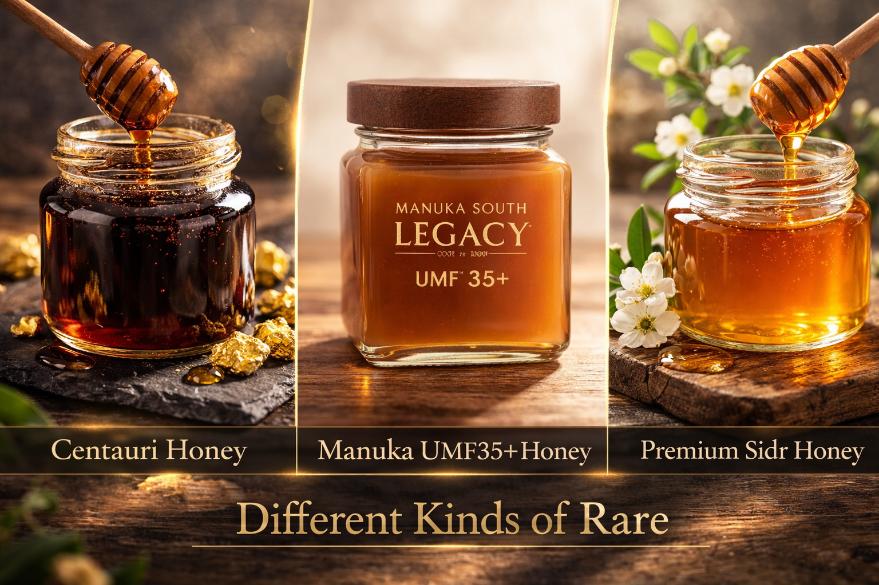
| Honey | Primary Rarity Driver | Scientific Transparency | Harvest Risk |
| Centauri | Extreme scarcity & narrative | Limited public data | Unclear |
| Elvish (Peri Balı) | Cave harvest | Limited | High |
| UMF 35+ Manuka | Chemical potency | Strong certification system | Low |
| Premium Sidr | Short bloom & heritage | Moderate | Low |
This comparison highlights an important distinction: not all luxury honeys derive their value from the same foundations.
Is Centauri Honey Worth the Price?
Value in luxury food products is not determined solely by nutritional superiority. It often reflects:
- Story
- Scarcity
- Geographic isolation
- Public recognition
- Market positioning
Centauri honey’s Guinness recognition elevated it into the global luxury spotlight. Whether its price reflects measurable compositional superiority or rarity amplified by narrative depends largely on the buyer’s perspective.
For collectors and luxury food enthusiasts, exclusivity itself can be part of the value proposition.
Authenticity & Buying Advice
Because ultra-premium honeys attract imitation:
- Request origin documentation where possible.
- Ask for laboratory analysis reports if available.
- Purchase through verified distributors.
- Be cautious of significantly discounted listings.
If a product labelled “Centauri honey” appears widely available at low cost, it is unlikely to correspond to the record-recognised batches.
The Broader Significance of Centauri Honey
Regardless of debate, Centauri honey achieved something notable: it shifted global perception of honey from everyday pantry staple to high-value luxury commodity.
It demonstrated that honey — when framed by rarity, geography, and storytelling — can occupy the same prestige tier as rare wines or truffles.
That cultural shift alone makes Centauri historically significant within the Rare & Luxury honey category.
Final Thoughts
Centauri honey represents the intersection of nature, narrative, and luxury economics. It is a rare product not only because of limited supply, but because of how it has been positioned in the global marketplace.

For readers exploring the upper tier of the honey world, Centauri serves as a fascinating case study — a reminder that rarity in honey can stem from chemistry, geography, heritage, or story.
And sometimes, from all four.
Frequently Asked Questions About Centauri Honey
What is Centauri honey?
Centauri honey is a rare Turkish honey associated with the Artvin region near the Black Sea. It gained global attention after being recognised by Guinness World Records as the most expensive honey ever sold.
Is Centauri honey harvested from caves?
Centauri honey is often linked to cave-origin narratives, but publicly available documentation about the exact harvesting method remains limited. It is commonly described as wild-harvested from remote, high-altitude environments.
How much does Centauri honey cost?
Centauri honey reportedly sold for approximately €10,000 per kilogram (around £8,700/kg) when recognised by Guinness World Records in 2021. Some luxury listings position it at even higher values, depending on batch and availability.
Is Centauri honey tested in laboratories?
Supplier sources state that batches undergo laboratory analysis before sale to assess composition and quality parameters. However, publicly available peer-reviewed scientific data is limited compared to certified honeys such as high-grade Manuka.
Is Centauri honey healthier than other honeys?
There is currently limited publicly available scientific evidence proving that Centauri honey offers superior health benefits compared to other premium honeys. Its value appears to derive primarily from scarcity and luxury positioning.
Why is Centauri honey considered rare?
Centauri honey is considered rare due to its extremely limited production, geographic isolation, discovery narrative, and record-breaking price recognition.