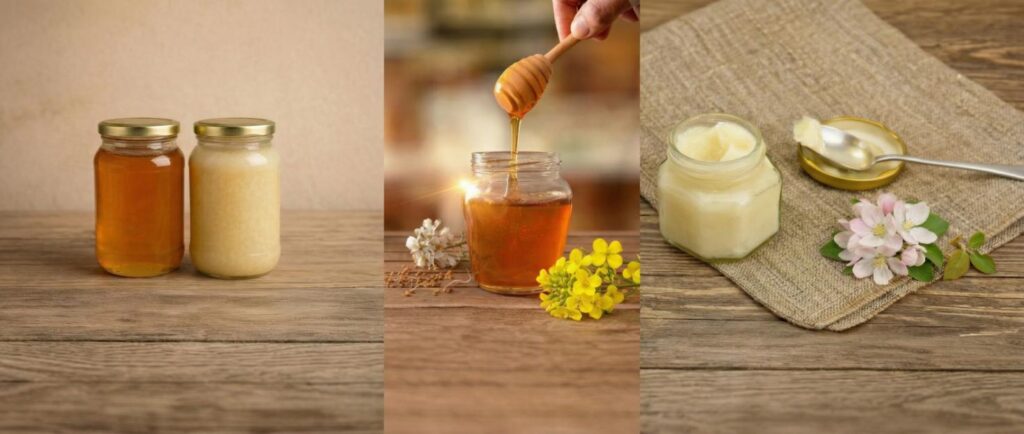
Most people misunderstand honey crystallisation — and often assume it means something has gone wrong. People often ask why honey turns solid, why some jars stay liquid in winter, whether heating honey ruins it, why white patterns appear on the surface, and whether fake honey crystallises too.
For beekeepers, this matters because customers often judge honey by appearance. For buyers, it matters because many people wrongly assume that a jar of set honey is spoiled, poor quality, or fake. In reality, the opposite is often true: crystallisation is normal in many genuine honeys.
What You Will Learn
- Why honey crystallises and what happens inside the jar
- Whether crystallised honey is safe to eat
- Why some honeys set quickly while others stay liquid
- What affects crystallisation speed
- What crystallisation really tells you about honey quality
What Is Honey Crystallisation?
Honey crystallisation is a natural process where liquid honey becomes thicker or solid as glucose forms crystals. It does not mean the honey has gone bad. Most raw honeys crystallise over time, especially at cooler temperatures.
Crystallisation is a natural physical process where honey changes from a liquid state into a thicker, grainy, or fully set form.
In everyday terms, it usually happens like this:
- the honey starts clear and liquid
- it gradually becomes cloudy
- it thickens
- eventually it sets
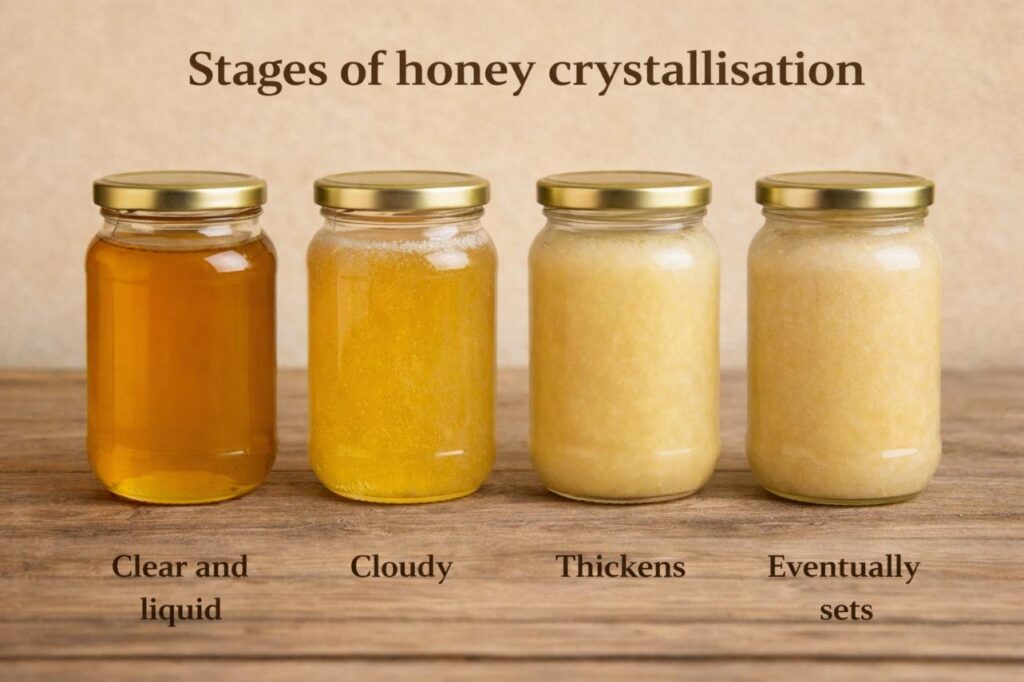
This is an entirely natural process, and the beneficial properties of honey are preserved. What often changes is the appearance: crystallised honey usually looks lighter, and its texture, flavour release, and aroma can feel slightly different.
Crystallisation is not spoilage.
In fact, it often indicates that the honey is:
- natural
- minimally processed
- not overheated
Crystallised honey is often called set honey, and sometimes described as “sugared” honey — which is really misleading as no sugar is added.
Why Does Honey Crystallise?
Honey crystallises because it contains glucose, which is less soluble than fructose. As temperature drops, glucose separates from the liquid and forms crystals, turning clear honey cloudy and eventually solid.
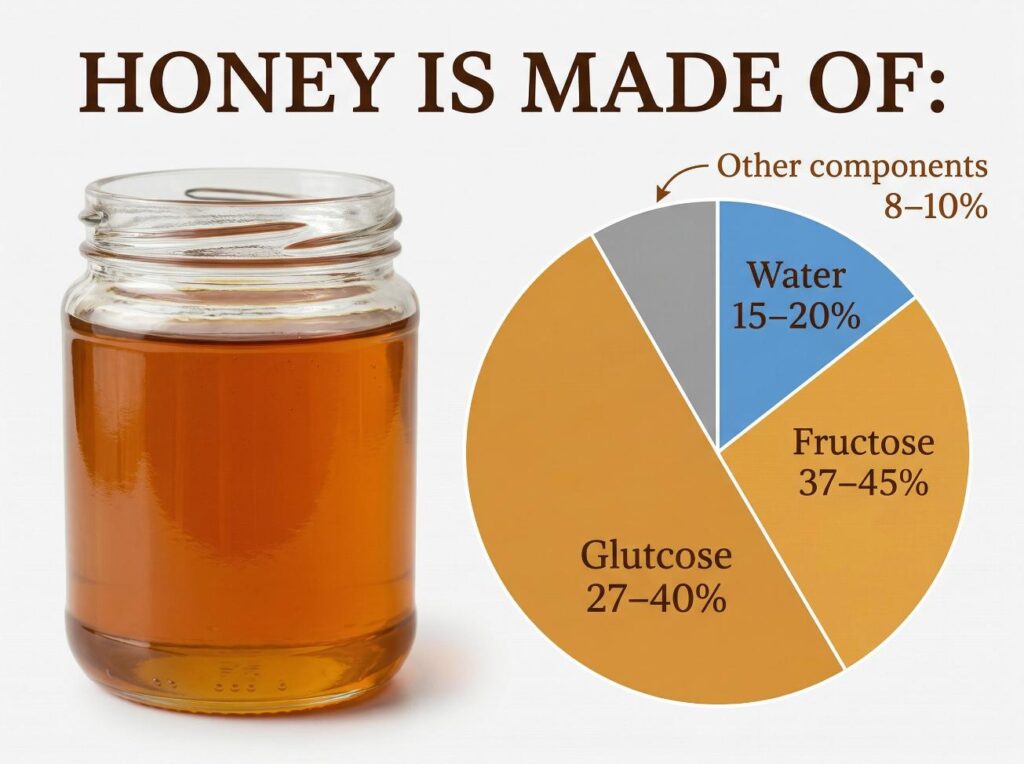
Honey is made mostly of:
- fructose
- glucose
- water
From a scientific point of view, it is a concentrated sugar solution that naturally tends towards crystallisation.
A Simple Way to Understand It
Think of sugar dissolving in hot water. Hot water can hold more sugar than cold water. When it cools, some sugar comes out of solution and forms crystals.
Honey behaves in a similar way.
Common Questions About Honey Crystallisation
Why does honey crystallise so quickly?
Honey crystallises quickly when it contains more glucose, natural particles like pollen, or is stored around 13–14°C.
Why is my honey grainy?
Grainy honey forms when larger glucose crystals develop. This affects texture but not safety.
Does refrigeration make honey crystallise?
Yes, refrigeration can accelerate crystallisation by lowering the temperature into an optimal range for crystal formation.
What Actually Happens Inside the Honey?
Inside the hive, bees process nectar at temperatures often above 30°C. Under these conditions, sugars remain dissolved.
Once the honey is extracted and stored at lower temperatures:
- glucose begins forming crystals
- fructose remains mostly liquid
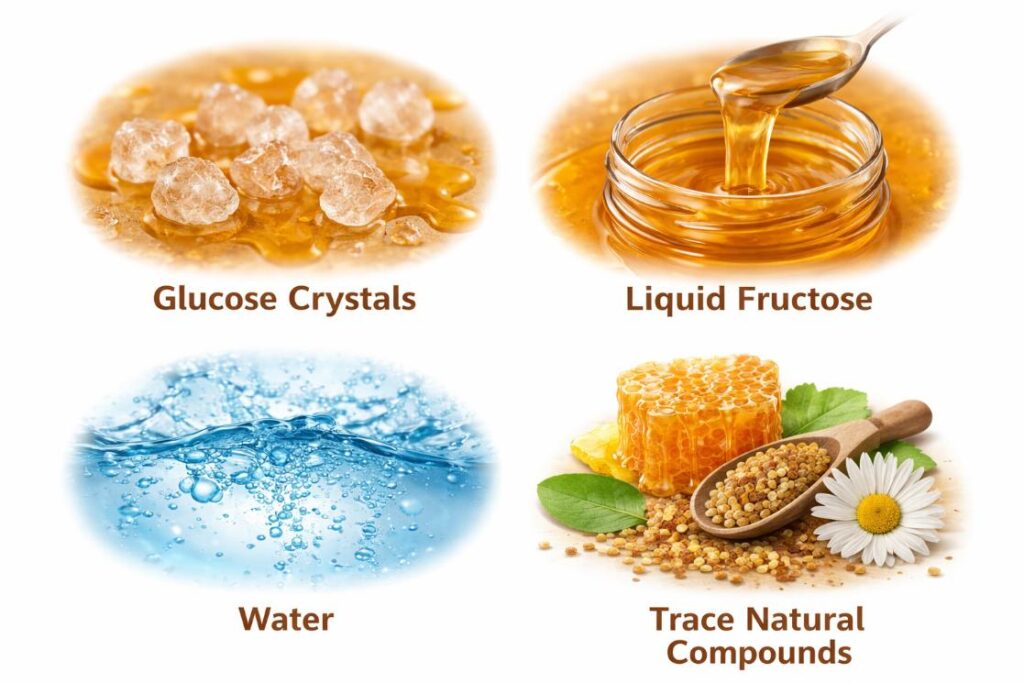
So crystallised honey is a mixture of:
- glucose crystals
- liquid fructose
- water
- trace natural compounds
What Does Crystallised Honey Look Like?
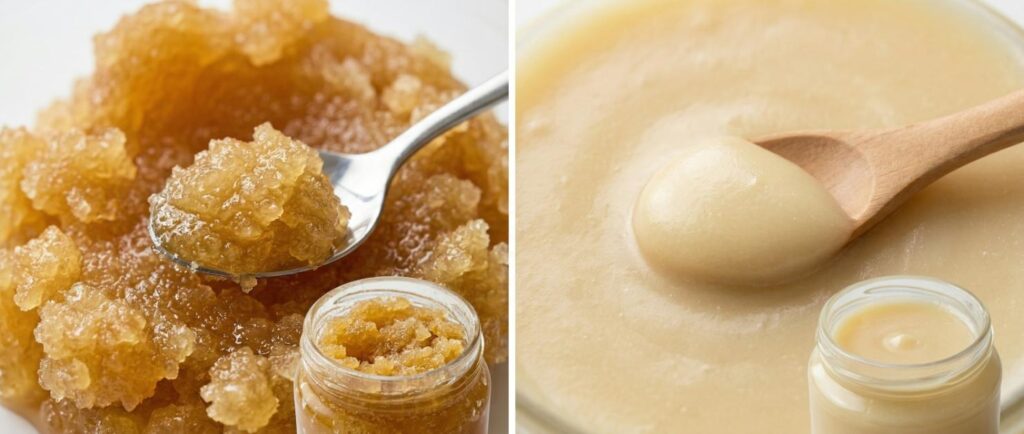
Crystallised honey can vary significantly in texture depending on crystal size.
It may be:
- coarse-grained (visible crystals)
- fine-grained (smooth texture)
- creamy (very fine crystals, spreadable)
This is why one jar may feel grainy while another feels smooth.
👉 If you want to explore how consistency varies, see our guide to honey texture and taste.
Why Some Honey Crystallises Quickly (and Some Doesn’t)
The speed of crystallisation depends mainly on:
- the sugar composition
- the storage temperature
1. Sugar Composition (Glucose vs Fructose)
Different floral sources produce different sugar ratios.
- more glucose → faster crystallisation
- more fructose → slower crystallisation
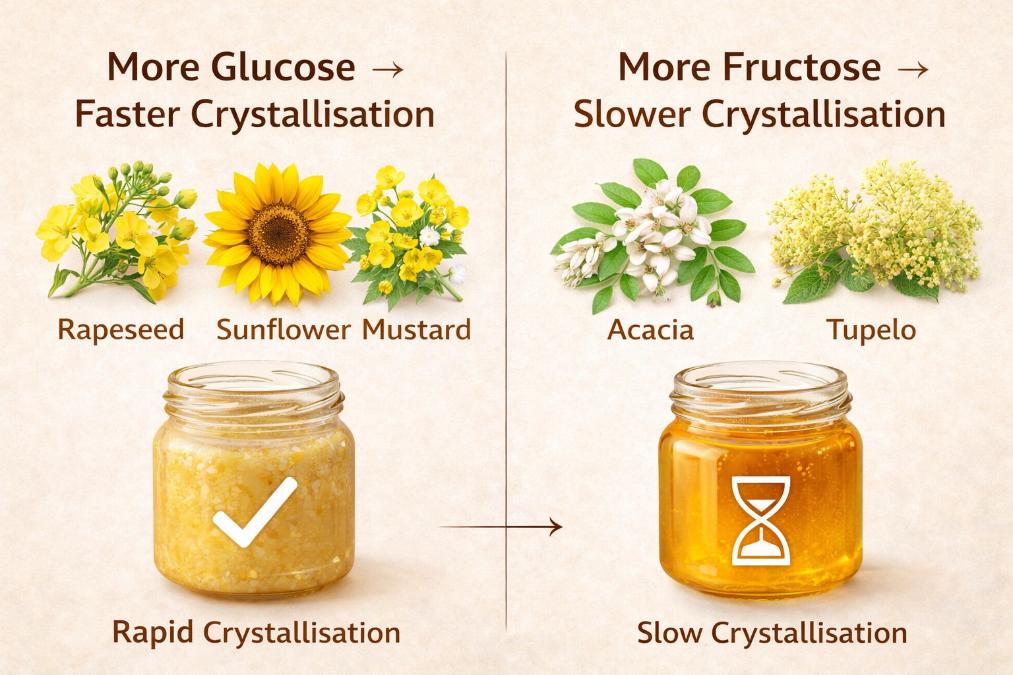
For example:
- rapeseed, sunflower, mustard → crystallise quickly
- acacia and some rare honeys → remain liquid longer
Because different floral sources behave differently, it helps to understand the main types of honey and how their composition affects texture and crystallisation.
🐝 Real Beekeeping Observation
Some honeys crystallise so quickly that the process can begin inside the hive.
Rapeseed honey is a classic example. Under certain conditions, it may start crystallising in the comb just weeks after bees bring it in.
I only fully appreciated this when I saw it myself in my own frames containing spring oilseed rape honey — parts of the honey had already begun to set before extraction.
This shows clearly that crystallisation is not a storage issue, but a natural property of the honey.
2. Temperature of Storage
Temperature strongly affects crystallisation:
- 27–32°C → may remain liquid
- 20–24°C → crystallisation slows
- 13–14°C → crystallisation is fastest
- below 4°C → slows again due to thickness
Stable temperatures slow the process, while fluctuations accelerate it.
Other Factors That Influence Crystallisation
Honey is more complex than just sugars and water.
Water Content
Slightly higher water content can slow crystallisation.
Other Sugars and Compounds
Substances like maltose, dextrins, and honeydew compounds can alter crystallisation behaviour.
Natural Particles (Crystallisation Centres)
These include:
- pollen
- wax particles
- proteins
- microscopic crystals
They act as starting points for crystal formation.
Reused Comb
Old crystals left in comb can seed new honey and speed up crystallisation.
Comb vs Jar Storage
Honey in comb stays liquid longer than extracted honey.
Movement
Stirring accelerates crystallisation — used intentionally in creamed honey.
Is Crystallised Honey Bad?
Crystallised honey is not bad. It is safe to eat and often indicates natural, minimally processed honey. It does not mean spoilage or fermentation.
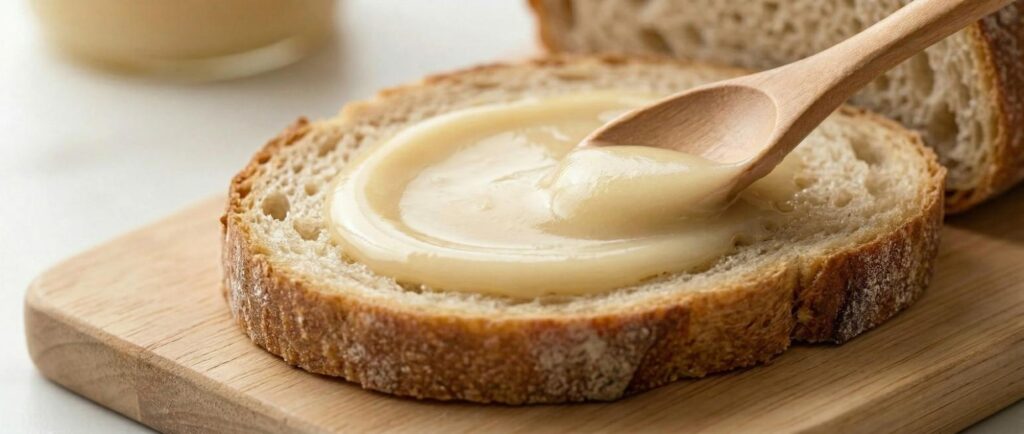
Many people prefer it because:
- it spreads easily
- it has a pleasant texture
- it retains full flavour
Quick Answers to Common Questions
Can you still use crystallised honey?
Yes, you can eat it as it is or gently warm it.
Does crystallised honey taste different?
The flavour is similar, but texture changes perception.
Is crystallised honey better than liquid honey?
Neither is better — both are natural forms.
Does Crystallisation Mean the Honey Is Pure?
Crystallisation can suggest minimal processing, but it is not a reliable authenticity test.
Both of these are myths:
- “If honey crystallises, it must be real”
- “If honey stays liquid, it must be fake”
Neither is consistently true.
👉 For a deeper explanation of grading systems such as UMF, MGO, and other markers of quality, see our guide to honey ratings and quality indicators.
👉 To understand what really determines quality beyond appearance, see our guide to choosing good honey.
Why Honey Sometimes Stays Liquid (Even in Winter)
Natural honey may remain liquid due to:
- higher fructose content
- floral source
- fewer crystallisation centres
- slightly higher water content
- stable storage
For example, some varieties such as Tupelo honey remain liquid much longer than most.
You Might Be Wondering
Which honey does not crystallise?
Some honeys like acacia or tupelo stay liquid longer.
How long does it take for honey to crystallise?
From a few weeks to over a year, depending on conditions.
Why Honey Turns White or Separates
Why does honey turn white?
White patches form due to crystallisation and air bubbles. This is harmless.
Why does honey separate?
Separation occurs when glucose crystallises while fructose remains liquid.
You may notice:
- white streaks
- cloudy patches
- layering
These are cosmetic changes, not spoilage.
👉 To understand this in detail, see our guide to why honey turns white, forms foam, and develops crystals.
Can You Turn Crystallised Honey Back Into Liquid?
Yes — gently.
To decrystallise honey safely, place the jar in warm water below 40°C and allow it to liquefy gradually. Avoid overheating or microwaving.
👉 If you want a full method, follow our guide on how to decrystallise honey without damaging it.
Should You Try to Prevent Crystallisation?
To slow crystallisation, store honey at stable room temperature, keep it sealed, and avoid refrigeration.
However, some honeys will crystallise regardless.
👉 If your aim is to slow the process, see how to keep honey liquid for longer with proper storage.
What Is Creamed Honey?
Creamed honey is honey that has been controlled during crystallisation to form very fine crystals, creating a smooth, spreadable texture.
It is not a defect — it is a traditional method.
👉 Learn more in our guide to what creamed honey is and how it is made.
The Most Important Takeaway
There is no universal rule that real honey must crystallise within a certain time.
Natural honey can:
- crystallise quickly
- crystallise slowly
- crystallise unevenly
- or remain liquid for a long time
Crystallisation is not a flaw. It is a natural expression of the honey’s composition.
FAQ about honey crystallisation
Why is my honey solid?
Honey becomes solid when glucose forms crystals. This is natural and not spoilage.
Why does honey crystallise?
Because glucose separates from the liquid as temperature changes.
Is crystallised honey bad?
No, it is safe and natural.
How can I make it liquid again?
Warm it gently below 40°C.
Why is my honey still liquid in winter?
Due to sugar balance, floral source, and storage conditions.
Does real honey always crystallise?
No, some remain liquid for long periods.
Why does honey turn white?
Due to crystallisation and trapped air.
Why does honey separate?
Because components crystallise at different rates.
At what temperature does it crystallise fastest?
Around 13–14°C.
Can fake honey crystallise?
Yes, so crystallisation alone is not proof of authenticity.
You Might Also Like
- Honey: A Complete Guide to Types, Taste, and Uses
- Honey Texture and Taste
- Honey Ratings and Quality Indicators
- Choosing Good Honey
- Honey Benefits
- How to Decrystallise Honey Safely
- How to Keep Honey Liquid for Longer