Why Bee Venom Therapy Attracts Attention in Arthritis Care
Joint pain and stiffness affect millions worldwide, prompting many people to explore natural remedies for arthritis alongside conventional treatment. One of the most debated — and misunderstood — options is bee venom therapy (BVT).
Used for centuries in traditional medicine, bee venom has gained modern attention for its anti-inflammatory and pain-modulating properties. But does it truly help joint pain, and is it safe?
This guide offers a clear, evidence-informed overview of bee venom therapy for arthritis, separating historical use, modern research, safety considerations and practical alternatives.
What Is Bee Venom Therapy?
Bee venom therapy is the controlled use of apitoxin — the venom produced by honey bees — for therapeutic purposes.
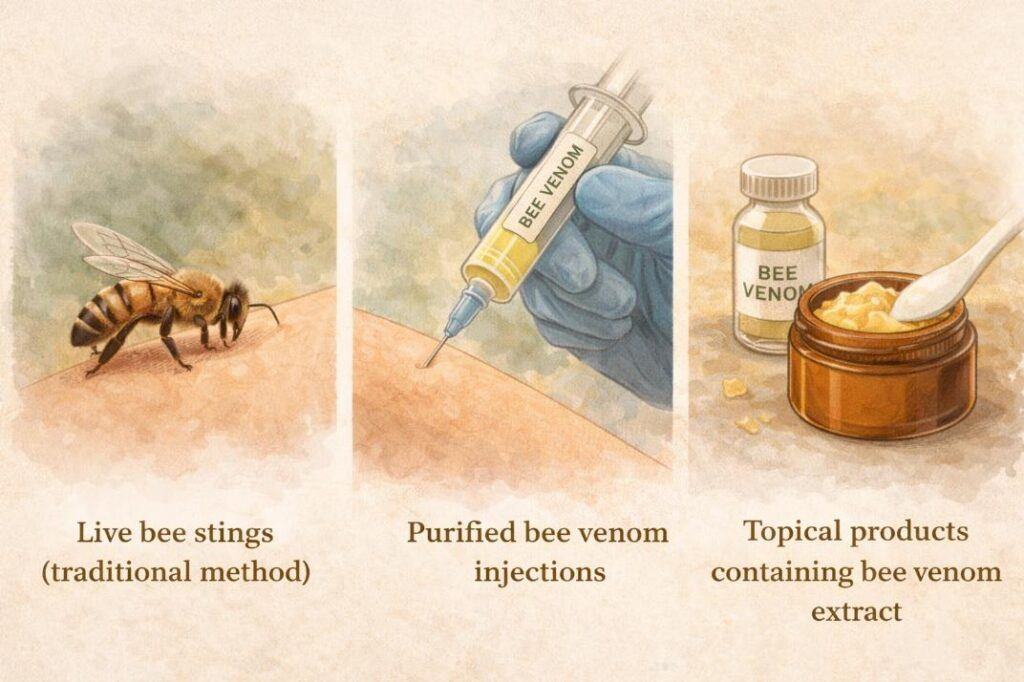
It may be administered through:
- Live bee stings (traditional method)
- Purified bee venom injections
- Topical products containing bee venom extract
Historically, practitioners believed that small, targeted exposure could stimulate healing responses and reduce chronic inflammation.
Today, BVT is sometimes explored for:
- Osteoarthritis
- Rheumatoid arthritis
- Chronic joint pain and stiffness
For a broader overview of how bee venom has been used historically, how it is collected today and key safety considerations, see our in-depth guide Bee Venom Made Simple: Traditional Use, Modern Research and Safety.
How Bee Venom Helps Arthritis: Proposed Mechanisms
Research suggests bee venom may influence arthritis symptoms through several biological pathways:
Anti-inflammatory effects
Bee venom contains compounds such as melittin and adolapin, which appear to:
- Suppress pro-inflammatory cytokines
- Reduce swelling and joint inflammation
Pain modulation
Some components interact with the nervous system, potentially:
- Interrupting pain signalling
- Reducing sensitivity around affected joints
Immune response regulation
In autoimmune conditions like rheumatoid arthritis, bee venom may help modulate immune overactivity, though this remains an area of active research.
These effects help explain interest in using bee venom for arthritis, but they do not guarantee safety or suitability for all individuals.
Bee Venom Benefits for Arthritis
What studies suggest
- Small clinical studies indicate potential improvements in pain scores and joint mobility
- Animal studies show reduced inflammation markers
- Some trials compare bee venom injections with acupuncture or anti-inflammatory drugs, with mixed results
Current limitations
- Many studies are small or short-term
- Dosage, delivery method and purity vary widely
- Long-term safety data is limited
Key takeaway: Bee venom therapy shows promise, but it is not a universally recommended arthritis treatment.
Bee Venom Therapy for Joint Pain: Safety First
⚠️ Allergy risk
Bee venom can cause severe allergic reactions, including anaphylaxis — even in people without known bee allergies.
Other potential side effects
- Local swelling and pain
- Infection at injection or sting sites
- Immune overstimulation with repeated exposure
Who should avoid bee venom therapy?
- Anyone with a known bee allergy
- Pregnant or breastfeeding women
- People with immune disorders unless supervised by a medical professional
Bee venom allergy treatment is a medical matter, and self-experimenting with venom products is strongly discouraged.
Best Practices for Bee Venom Therapy
If someone considers bee venom therapy, best practices include:
- Medical allergy testing beforehand
- Supervision by a qualified practitioner/ apitherapist
- Avoiding live bee stings outside clinical settings
- Using standardised, purified extracts where it is legal and regulated
- Never stopping prescribed arthritis medication without medical advice
This cautious approach is essential when exploring bee venom therapy for chronic pain.
Comparing Bee Venom vs Other Therapies for Arthritis
| Approach | Evidence Strength | Risk Level |
| Bee venom therapy | Emerging / limited | Moderate–high |
| Propolis (oral/topical) | Moderate | Low |
| Anti-inflammatory diet | Strong | Very low |
| Physiotherapy | Strong | Very low |
| NSAIDs (non-steroidal anti-inflammatory drugs) | Strong | Low-moderate if used short-term High if used long-term |
Natural Remedies for Arthritis: Safer Alternatives to Consider
Other beehive products may offer gentler support, such as propolis, which has been studied for its immune-modulating and anti-inflammatory properties (explored further in anti-inflammatory properties of propolis).
Before exploring venom-based therapies, many people also find relief through:
- Raw honey (antioxidant support)
- Beeswax balms (joint warmth and skin barrier care)
- Omega-3-rich diets
- Gentle movement and heat therapy
These options align well with a holistic beehive-products approach and carry far fewer risks.
Final Thoughts
Bee venom therapy occupies a fascinating space between ancient practice and modern research. While its anti-inflammatory potential is real, so are its risks.
For arthritis sufferers, informed decision-making is key which is based on:
- Understanding the evidence
- Respecting safety boundaries
- Prioritising low-risk, supportive therapies first
Used responsibly — or avoided when appropriate — bee venom remains an interesting but specialised option, not a universal solution.
FAQ
Is bee venom therapy proven to cure arthritis?
No. There is no cure for arthritis, and bee venom therapy is not a cure.
Can bee venom help arthritis pain long-term?
Some report short-term relief, but long-term effectiveness is not well established.
Is topical bee venom safer than injections?
Topical products are generally lower risk but still unsuitable for those with allergies.
Does bee venom help inflammation?
Laboratory and small clinical studies suggest anti-inflammatory effects.
Is bee venom legal and regulated?
Regulation varies by country; medical-grade products should meet safety standards.
Can athletes use bee venom for joint recovery?
Some explore and use bee venom for athletic recovery with successful results, particularly when it is applied in the form of cream topically.
References
This article draws on peer-reviewed research from medical, pharmacological and apitherapy journals to ensure accuracy and balance.
These sources reflect current scientific understanding and are provided for educational purposes rather than medical guidance.
Bilò, M.B. et al. (2005) ‘Diagnosis of Hymenoptera venom allergy’, Allergy, 60(11), pp. 1339–1349.
→ Foundational clinical reference on bee venom allergy and safety.
Bogdanov, S. (2016) Bee venom: Production, composition and quality control. Bee Product Science.
→ Widely cited overview of bee venom composition and ethical production.
Huh, J.E. et al. (2010) ‘Bee venom inhibits inflammation and osteoclastogenesis in a collagen-induced arthritis model’, International Immunopharmacology, 10(8), pp. 962–969.
→ Key study supporting bee venom’s anti-inflammatory role in arthritis research.
Kwon, Y.B. et al. (2002) ‘Antinociceptive effects of bee venom acupuncture in chronic inflammatory pain’, Neuroscience Letters, 330(2), pp. 83–86.
→ Early but influential work on pain modulation and venom therapy.
Lee, J.D. et al. (2004) ‘An overview of bee venom acupuncture in the treatment of arthritis’, Rheumatology, 43(5), pp. 675–680.
→ Clinical overview bridging traditional use and modern rheumatology.
Son, D.J. et al. (2007) ‘Therapeutic application of anti-arthritis and pain-releasing effects of bee venom’, Pharmacology & Therapeutics, 115(2), pp. 246–270.
→ Comprehensive review of mechanisms and therapeutic potential.
Wehbe, R. et al. (2019) ‘Bee venom: Overview of main compounds and bioactivities’, Toxins, 11(12), 743.
→ Modern, well-cited summary of bioactive compounds including melittin.